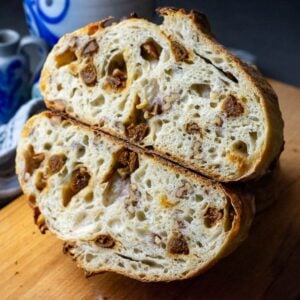
Fig and Walnut Sourdough Bread
This fig and walnut sourdough bread is a festive, slow-fermented loaf with a crisp crust, a chewy open crumb, jammy dried figs, nutty toasted walnuts and a little honey and fresh orange zest. It is a sourdough bread with dried fruit and nuts that earns its place on a Christmas cheeseboard, and it is just as good simply toasted with butter for breakfast.
Equipment
- Bench Scraper
- Kitchen scissors (for snipping the figs)
- Dry frying pan (for toasting the walnuts)
- Batard (oval) banneton or lined oval basket
- Razor Blade or Bread Lame
Ingredients
- 500 g strong white bread flour at least 12% protein
- 310-330 g water depending on how much water your flour absorbs
- 160 g active sourdough starter 100% hydration
- 10 g sea salt
- 25 g clear honey approximately 1 tablespoon
- Finely grated zest of 1 large unwaxed orange about 6 to 8g
- 100 g soft dried figs stems removed, snipped into roughly 1cm pieces (no soaking needed, see notes)
- 100 g walnut halves toasted in a dry pan, cooled and roughly chopped
Instructions
DAY 1
- Feed your starter. In the morning, feed your starter 1:1:1 (70g starter, 70g water, 70g strong white flour). Leave it semi-covered somewhere warm, 21-27°C (70-81°F), for 4-5 hours, until it has at least doubled and looks bubbly and domed.
- Prep the walnuts and figs. Toast the walnuts in a dry frying pan over a medium heat, stirring often, until fragrant. Tip them onto a plate and let them cool completely, then roughly chop. Snip the stems off the figs and cut each one into roughly 1cm pieces with kitchen scissors (dip the blades in water if they stick). Cover both and set aside.
Mix The Dough
- Add the orange zest to the honey and crush it into the honey with the back of a spoon, stirring, until fragrant.
- Put the flour, water, active starter, salt and the orange honey into the bowl of a stand mixer fitted with the dough hook. Mix until no dry flour remains and the dough comes together into a smooth, cohesive dough, about 10 minutes.
Coild Folds and Bulk Fermentation
- Transfer the dough to a large bowl, cover and leave in a warm place, 21-27°C (70-81°F), for 30-40 minutes.
- With cold, wet hands, lift the dough from the middle, let the sides tuck under, rotate the bowl a quarter turn and repeat until you have done all four sides.
- Cover and rest for 30-40 minutes. Do 4 sets of coil folds in total, 30-40 minutes apart.
- After the last coil fold, cover and leave the dough undisturbed for 3-4 hours. Judge the dough rather than the clock. It is ready at roughly a 75% rise, with a puffy, slightly domed surface and visible bubbles at the sides and base. Do not wait for it to double.
Add Mix-Ins and Shape
- Turn the dough out and gently stretch it into a large rectangle. Scatter half of the figs and walnuts over the surface and fold the dough like a pamphlet (one third over, then the other third over that). Scatter the rest of the figs and walnuts on top, then roll the dough up into a batard shape. Tuck in any figs or walnuts that are poking out, because exposed fruit and nuts burn in the oven. Pinch the ends and the seam closed.
Cold Ferment
- Place the dough seam-side up in a floured batard banneton or basket.
- Put it inside a large plastic bag so the surface doesn't dry out, and refrigerate for 12-24 hours, generally overnight.
DAY 2
- Place your Dutch oven, with its lid, in the oven and preheat to 240°C (465°F), so it is piping hot all the way through.
Score
- Take the dough straight from the fridge (no resting at room temperature). Turn it out onto a sheet of parchment paper and dust with flour. The dough will feel stiffer than usual for its hydration, because the figs soak up a little water overnight. That is normal.
- Score with a bread lame or razor blade at a 30-45° angle, about 1cm deep, in one confident slash.
Bake and Cool
- Carefully lift the hot Dutch oven out and remove the lid. Lower the dough in using the parchment, keeping the score open, and replace the lid. Bake covered for 40 minutes, then remove the lid and bake for another 10 minutes, until deep golden brown. Honey and fig sugars brown quickly, so if the crust is getting too dark, reduce the oven to 200°C (400°F) for the remaining time. The loaf is done when it sounds hollow underneath and reads 96-98°C (205-210°F) in the centre.
- Lift the loaf out using the parchment and set it on a wire rack, then slide the parchment out from underneath. Cool completely before slicing, at least 1 hour and ideally 2. Cut too early and the soft fig pockets smear and the crumb turns gummy.
Notes
Figs: Use soft, plump, ready-to-eat dried figs (Turkish or Calimyrna work well). If yours are firm or leathery, cover them with just-boiled water for 10 minutes, drain and pat very dry before cutting.
Nutrition
Calories: 2930kcalCarbohydrates: 491gProtein: 83gFat: 75gSaturated Fat: 7gPolyunsaturated Fat: 51gMonounsaturated Fat: 10gSodium: 3917mgPotassium: 1635mgFiber: 30gSugar: 73gVitamin A: 40IUVitamin C: 3mgCalcium: 348mgIron: 10mg
Tried this recipe?Let us know how it was!