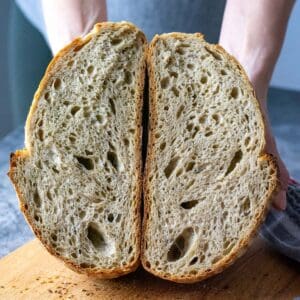
London Fog Sourdough Bread (With Earl Grey Tea)
This London Fog sourdough bread takes the flavours of the classic Earl Grey latte and bakes them into a crusty, free-standing sourdough boule. Steeped Earl Grey tea, warm milk and a little honey give it a subtle sweetness, with optional lavender for extra floral depth. Baked in a Dutch oven for a proper crackly crust, it's irresistible toasted with salted butter generously slathered on top.
Equipment
- Bench Scraper
- Banneton Basket
- Razor Blade or Bread Lame
Ingredients
For Steeping The Tea:
- 2 Earl Grey tea bags for steeping the milk
- 200 g whole milk
For Sourdough:
- 35 g clear honey ~1½ tablespoons
- 1 teaspoon vanilla bean paste optional
- 150 g water
- 500 g strong bread flour 12.5% protein minimum
- 11 g sea salt
- 3 g finely ground Earl Grey tea (about 1 tea bag)
- 1-3 g dried culinary lavender optional
- 160 g active sourdough starter 100% hydration
- 25 g unsalted butter very soft
Instructions
DAY 1:
Feeding Your Starter
- First thing in the morning, feed your sourdough starter. I typically feed 70g of my starter in a ratio of 1 part starter : 1 part water : 1 part flour – so 70g starter, 70g water, 70g flour. Scoop into a clean jar and leave in a warm spot (21-27°C), semi-covered, for 4-5 hours.
Steeping the Tea
- Heat the milk in a small pan until steaming but not boiling, pour it over the 2 tea bags, and leave to steep for 8-10 minutes. Squeeze out and discard the bags.
- Add the honey and vanilla to your tea, and stir to combine. Finally, pour in the water and mix.
- Leave the milk mixture to cool completely to room temperature before you use it - it needs to be well below body temperature or it'll knock your starter about. You can do this the night before and keep it in the fridge, just bring it back to room temp before mixing.
Mixing The Dough
- Once your starter is active, bubbly, and at least doubled in volume, combine the flour, salt, finely ground Earl Grey and lavender (optional) in a bowl of your stand mixer. Add the cooled down milk mixture and active sourdough starter. Mix with the dough hook on medium-low for 5-7 minutes until you have a cohesive dough with no dry bits of flour remaining.
- Bit by bit, add the soft butter and mix for a further 6-8 minutes until everything is fully incorporated and the butter has disappeared into the dough.
Coil Folds and Bulk Fermentation
- Scoop the dough into a large bowl, cover with a damp kitchen towel or plastic wrap, and leave in a warm place (21-27°C) for 30 minutes. After 30 minutes, with cold wet hands, perform the first set of coil folds. Lift the dough from the sides with both hands and tuck it under itself to form a coil. Rotate the bowl a quarter turn and repeat. Cover and rest for 30 minutes. Repeat every 30 minutes for a total of 4 sets (if you'd rather stretch and fold, that works just as well here - go a little gentler than usual, this dough is slightly enriched and doesn't need much convincing).
- After all the folds are complete, leave the covered dough undisturbed for 2-3 hours. Bulk fermentation is done when the dough looks puffy, has visible bubbles at the surface, and has increased by around 50-75% in volume - go by how it looks rather than the clock.
Shaping and Final Proof
- At the end of bulk fermentation, using a bowl scraper, turn the dough out onto a lightly floured surface, smooth side down. Fold the four corners into the centre, then flip the dough over. Using a bench scraper held at a shallow angle to the surface, push the dough while your free hand tucks it under itself, building tension. Work the dough into a tight round ball that holds its shape and doesn't spread.
- Place the shaped dough ball smooth-side down into a well-floured banneton (rice flour is best for lining). Pinch the seam at the top to keep the shape tight. Cover and place the banneton in the fridge. Refrigerate for 12-36 hours for the cold proof (final rise).
DAY 2:
Preheating The Oven
- Place the Dutch Oven into the oven from cold, then set it to preheat to 230°C (445°F).
Scoring The Dough
- Once the oven is fully up to temperature, take the dough straight from the fridge (don't let it come to room temperature - cold dough scores more cleanly).
- Invert the dough gently onto a large piece of parchment paper. Using a bread lame or razor blade, score the dough firmly at a 30-45° angle, approximately 1cm deep. One confident slash is all you need for an open ear.
Baking
- Carefully remove the hot Dutch Oven from the oven and take off the lid. Lift the dough into the pot using the edges of the parchment paper, keeping the scored slash open as you lower it in. Replace the lid. Bake with the lid on for 50 minutes.
- TIP: - Earl Grey Sourdough browns very fast, due to milk and honey content in it, even with the lid on for the full baking time. I recommend you check your bread at 40 minutes, and if your bread is burning on top, reduce the oven temperature to 180-200°C (360-390℉), place the lid back on and bake for further 10 minutes.
Cooling
- Lift the loaf out of the Dutch Oven using the parchment paper and place on a wire rack. Slide the paper out from underneath. Leave to cool completely before slicing. This one's worth the wait a bit more than a lean loaf, since the milk and butter mean the crumb needs longer to fully set.
Video
Nutrition
Calories: 2377kcalCarbohydrates: 434gProtein: 71gFat: 35gSaturated Fat: 18gPolyunsaturated Fat: 5gMonounsaturated Fat: 7gTrans Fat: 1gCholesterol: 78mgSodium: 4363mgPotassium: 827mgFiber: 13gSugar: 43gVitamin A: 962IUVitamin C: 0.3mgCalcium: 338mgIron: 5mg
Tried this recipe?Let us know how it was!