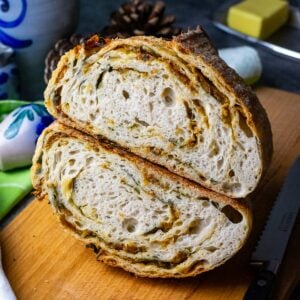
Sage and Onion Sourdough Bread (Stuffing Sourdough Bread)
Take the best bit of the roast dinner, the sage-heavy stuffing everyone hovers over, and bake it into a crackly sourdough loaf. This stuffing sourdough bread is packed with jammy caramelised onions, fresh sage and black pepper.
Equipment
- Stand mixer with dough hook (or a big bowl and your hands)
- Banettone basket
- Dutch oven or large lidded casserole
- Bench scraper, lame or sharp knife
Ingredients
For the caramelised onions
- 500 g brown onions about 3 medium, thinly sliced
- 25 g unsalted butter
- 1 tablespoon olive oil
- Pinch of salt
- 4 g fresh sage leaves about 10 leaves, finely chopped
For the dough
- 500 g strong bread flour 12% protein minimum
- 10 g salt
- 1 g freshly ground black pepper (about ½ tsp)
- 300 g water
- 160 g active sourdough starter 100% hydration
Mix-ins
- 150 g caramelised onions cooked weight, fully cooled
- 6 g fresh sage leaves about 15 leaves, roughly chopped
Instructions
DAY 1:
Feed Sourdough Starter:
- First thing in the morning, feed your starter and leave it at 21–27°C (70–81°F) for about 4 hours, until doubled, bubbly and domed.
Make The Onions
- Melt the butter with the olive oil in a large frying pan over medium-low heat. Add the onions and a pinch of salt and stir to coat.
- Cook for 40–50 minutes, stirring every 5 minutes or so. If they start catching, add a splash of water and scrape up the sticky bits. You want them deep golden brown, soft and jammy, not crisp.
- Stir in the 4g finely chopped sage for the last 2 minutes so it cooks in the butter. This is the bit that makes it smell like Christmas stuffing.
- Tip onto a plate, spread out and cool completely. Weigh out 150g. Cold onions are non-negotiable, because warm ones will speed up fermentation and turn the dough slack. If you have extra, keep it for toast.
Mix The Dough
- Add the flour, salt and black pepper to the bowl of your stand mixer and stir briefly.
- Add the water and starter. Mix with the dough hook for 10–15 minutes, until the dough is smooth and comes away from the sides of the bowl. It will feel quite firm at this point. The onions loosen it later.
- Cover and rest for 30 minutes.
Coil Folds and Bulk Fermentation
- Do 4 sets of coil folds, 30 minutes apart, keeping the dough covered between sets.
- Put the dough back in a lightly oiled bowl, cover it, and leave it at 21–27°C (70–81°F) for 3–4 hours. It's ready when it has grown 50–75%, has a domed, slightly jiggly surface and shows bubbles at the sides of the bowl.
Shape, Add Mix-Ins And Cold Retard
- Tip the dough onto a lightly floured or wet surface and stretch it out into a rectangle, pulling gently from the middle outwards.
- Scatter ⅔ of the onions and ⅔ of the raw sage over the surface. Pull any clumps of onion apart as you go, because big wet pockets turn into gummy holes. Fold one side of the dough over into the middle. And the other side over - like a letter or a pamphlet.
- Add the last third of the onions and sage, then roll up from the short end to shape a battard. Pinch the ends together to seal in the filling and tuck in any onion poking out of the surface. See the video below for a visual illustration.
- Place seam-side up in a well-floured oval banneton. Stitch it, if it spreads in the basket. Put it in a plastic bag (or not, if your fridge doesn't tend to dry the dough out) and refrigerate at about 4°C (39°F) for 12–18 hours.
DAY 2:
- Put the Dutch oven in the oven and preheat to 240°C (465°F).
- Turn the dough out onto baking paper. Score one long, confident slash about 1cm deep at a 30–45° angle down the length of the loaf.
- Lower it into the hot Dutch oven, put the lid on, and bake for 40 minutes.
- After 40 minutes, reduce the oven to 200°C (400°F), and bake for another 12-15 minutes. Do not remove the lid (you can remove it to take a peek, but place it back on to continue baking). The sugar in the onions browns the crust faster than on a plain loaf, and they will burn if you bake this loaf uncovered. If you have a thermometer, the inside should read 96–98°C (205–208°F).
- Cool on a wire rack for at least 2 hours before slicing. Onion-heavy crumb is still setting as it cools.
Video
Notes
Onion weight: 500g raw onions cook down to roughly 150–170g. If you'd rather roast the onions, 150g is still your target.
Sage: Using some cooked sage and some raw gives both the mellow, buttery stuffing flavour and a fresh herby hit. Don't swap in dried sage 1:1, because it gets dusty and bitter. If you have to use it, use about 1½ teaspoon and put it in the onions only.
Optional extras: a few fresh thyme leaves with the sage, or 50g toasted chopped chestnuts laminated in with the onions for a proper Christmas stuffing version.
Nutrition
Calories: 2520kcalCarbohydrates: 455gProtein: 72gFat: 44gSaturated Fat: 16gPolyunsaturated Fat: 6gMonounsaturated Fat: 16gTrans Fat: 1gCholesterol: 54mgSodium: 3932mgPotassium: 1473mgFiber: 24gSugar: 29gVitamin A: 648IUVitamin C: 48mgCalcium: 269mgIron: 6mg
Tried this recipe?Let us know how it was!