
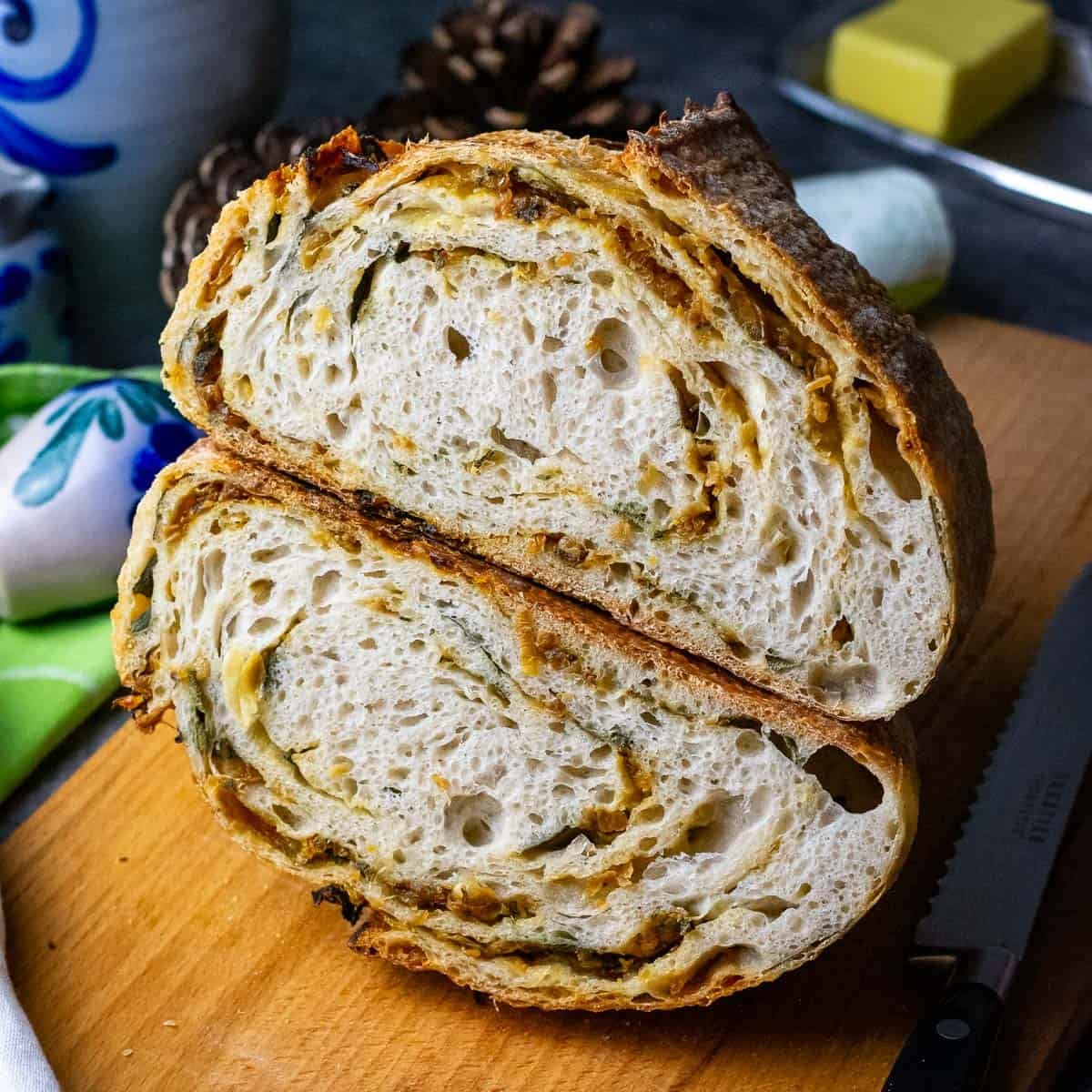
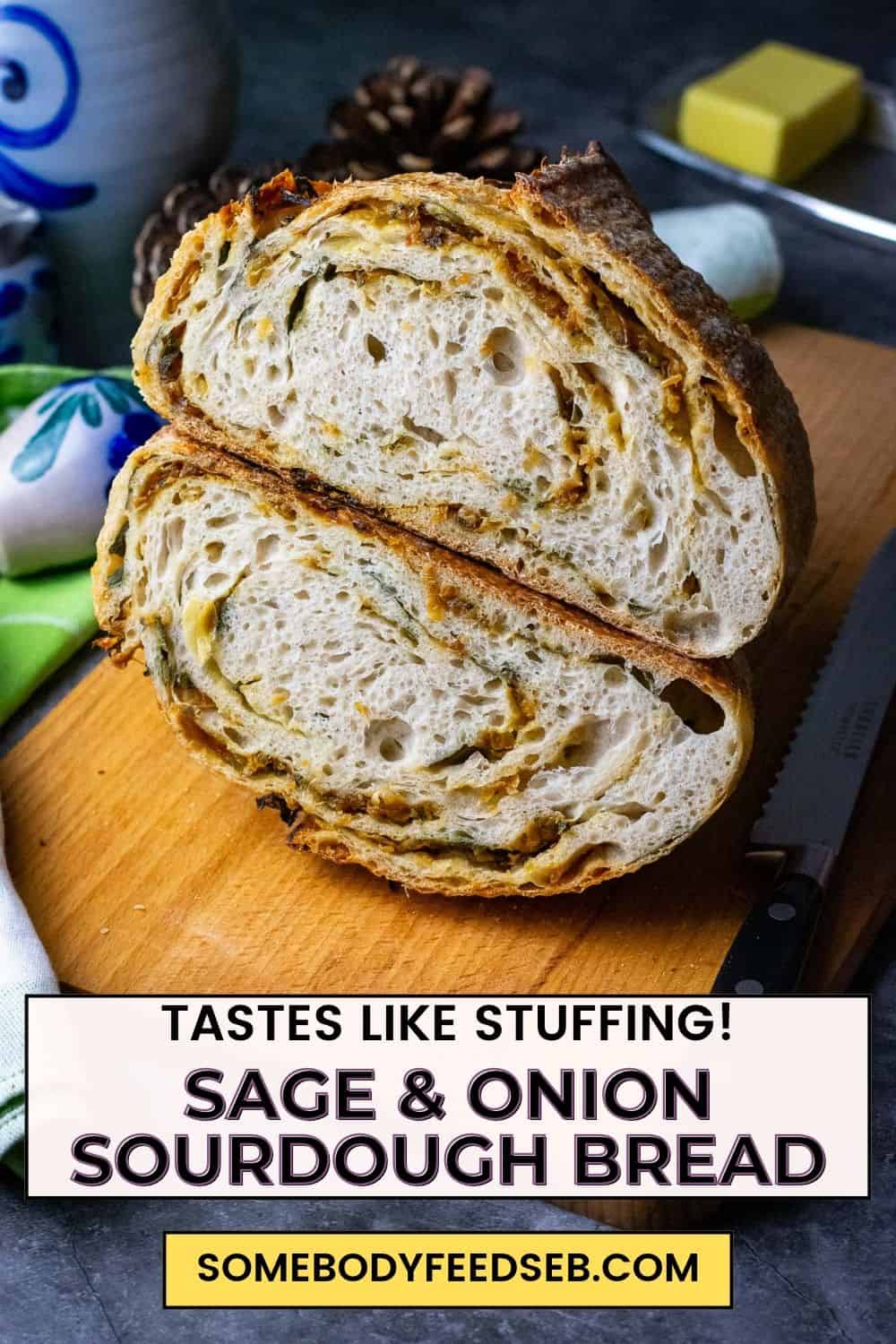
Take the best bit of the roast dinner, the sage-heavy stuffing everyone hovers over, and bake it into a crackly sourdough loaf. This stuffing sourdough bread is packed with jammy caramelised onions, fresh sage and black pepper. It's a loaf you slice and butter, not stuffing made from sourdough (though I'll show you how to turn it into that too).
Jump to:
- Recipe Highlights
- What Makes This Bread Taste Like Stuffing
- Ingredient Notes
- Method and TIPS
- Tips For Success
- Variations
- What To Serve With Stuffing Sourdough Bread
- Can You Make Stuffing With Stuffing Bread?
- Recipe FAQs
- How To Store Stuffing Sourdough Bread
- More Sourdough Recipes To Try
- Sage and Onion Sourdough Bread (Stuffing Sourdough Bread)
As an Amazon Associate I earn from qualifying purchases, at no extra cost for you! Thank you!
Fair warning: when the sage hits the buttery onions, your house will smell like Christmas dinner, and someone will ask what time the turkey's going in.

Recipe Highlights
TASTE: Savoury, peppery, sweet onion, buttery sage finish
SAGE, TWICE: Bloomed in butter, then folded in raw
BEST BIT: The leftover turkey sandwich the next day
SEB'S RATING: "It's stuffing you can put butter on."

What Makes This Bread Taste Like Stuffing
Three things do the heavy lifting. The first is onions cooked low and slow for the best part of an hour, until they're soft, jammy and deeply savoury. That's roast-dinner depth, not the sticky sweetness of onion chutney.
The second is sage, added twice. A little is stirred into the onions at the end so it cooks in the butter, which gives you that mellow, familiar stuffing note. The rest goes in raw during lamination, so every slice also gets a fresh, herby hit.
The third is black pepper in the dough itself, because stuffing without pepper is just bread and onions.
Ingredient Notes
- Strong bread flour. Look for at least 12% protein. The onions weigh 30% of the flour and bring a lot of moisture with them, so you need a flour that builds enough gluten to carry that load without the dough going slack.
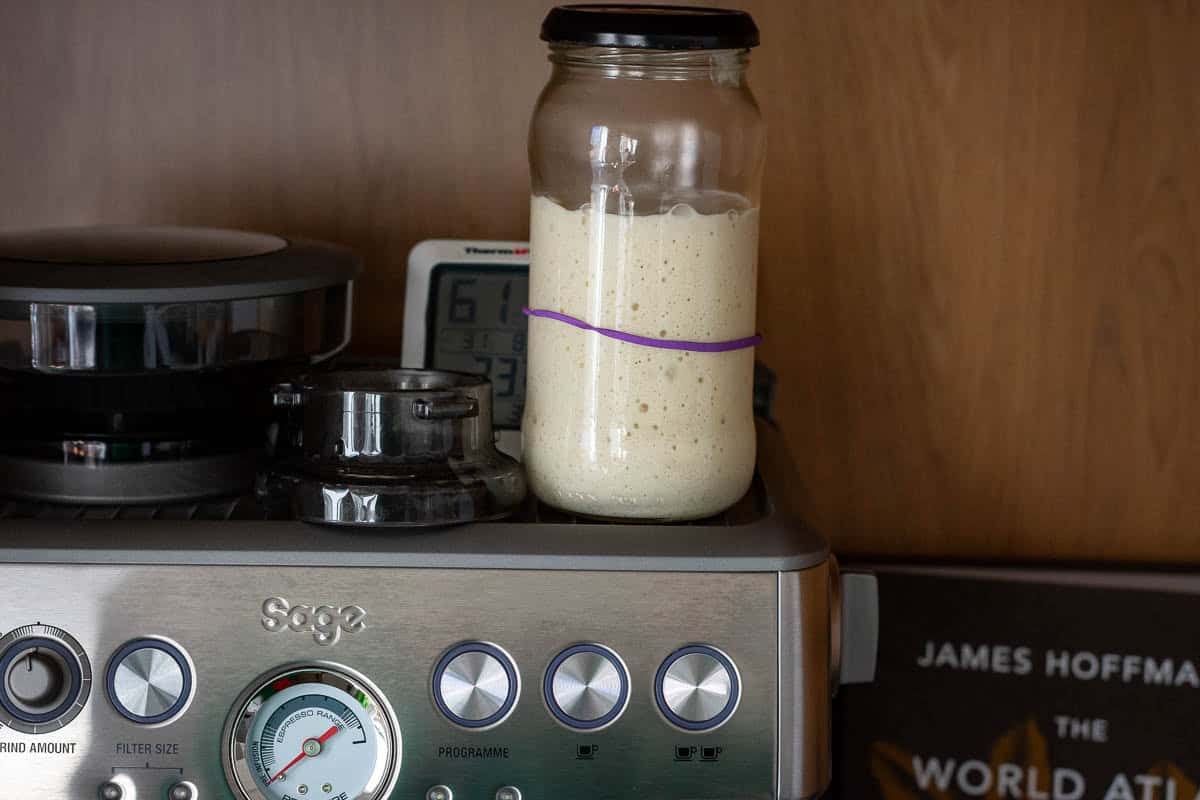
- Active sourdough starter. We use 100% hydration starter in most of our recipes.
- Brown/ yellow onions. They have enough natural sugar to caramelise well, plus the sharp, savoury backbone that reads as stuffing. Red onions turn sweeter and can tint the crumb a murky purple, and sweet onions lose that savoury edge. 500g raw onions (about 3 medium) cook down to roughly 150-170g, and 150g cooked weight is what goes into the dough. Onions vary so much in size and water content that "1 onion" is basically a guess, so weigh them. Roasting works too, as long as you end up with 150g.
- Fresh sage. Dried sage goes dusty and slightly bitter in bread, and it can't do the fresh, raw-herb job at all. If it's all you have, use about 1½ teaspoons, stir it into the onions only, and skip the raw sage in the lamination.
- Butter and olive oil. Butter brings the flavour. The splash of oil helps stop the butter burning over a 40-50 minute cook.
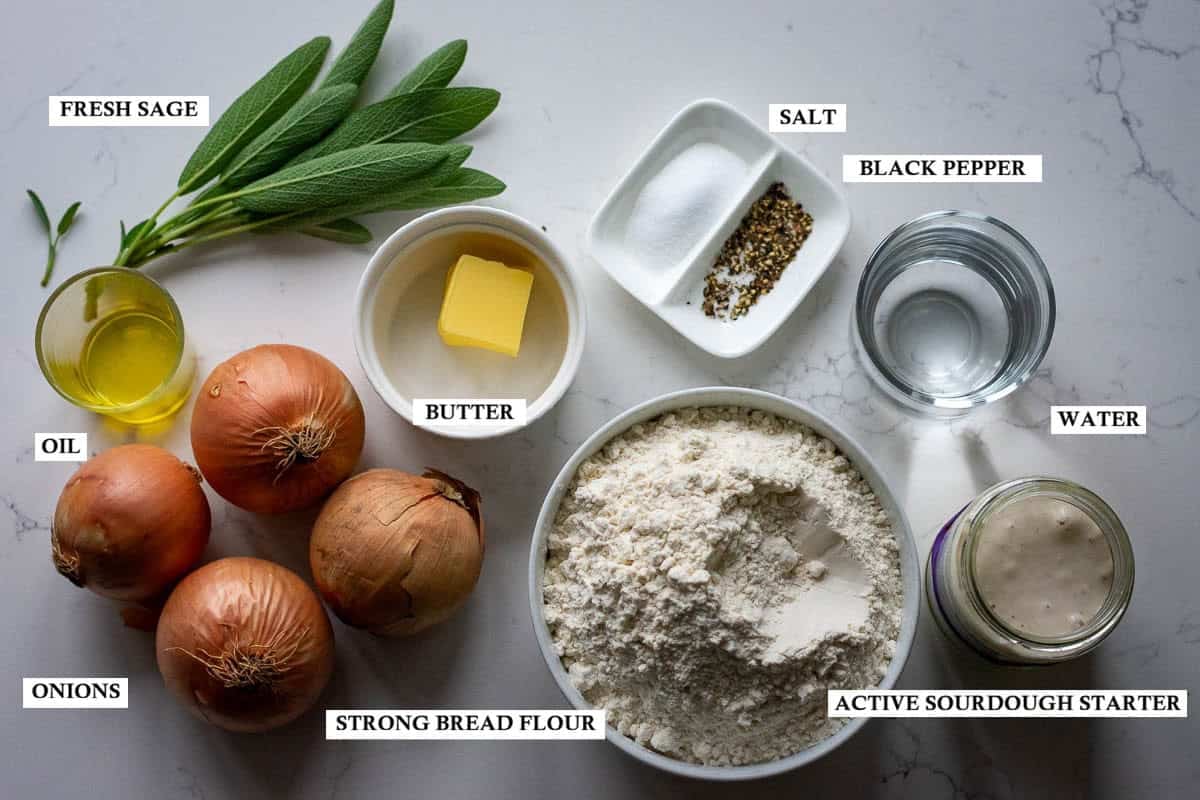
Find the full ingredient quantities and instructions in the recipe card below.
Method and TIPS
This is a two-day bake. Most of it is waiting, and the only stage that asks for real attention is the lamination.
Day 1
Caramelise the Onions While Your Starter Rises
Feed your starter first thing, then start the onions straight away. They take about as long as the starter does, and they need time to cool afterwards.
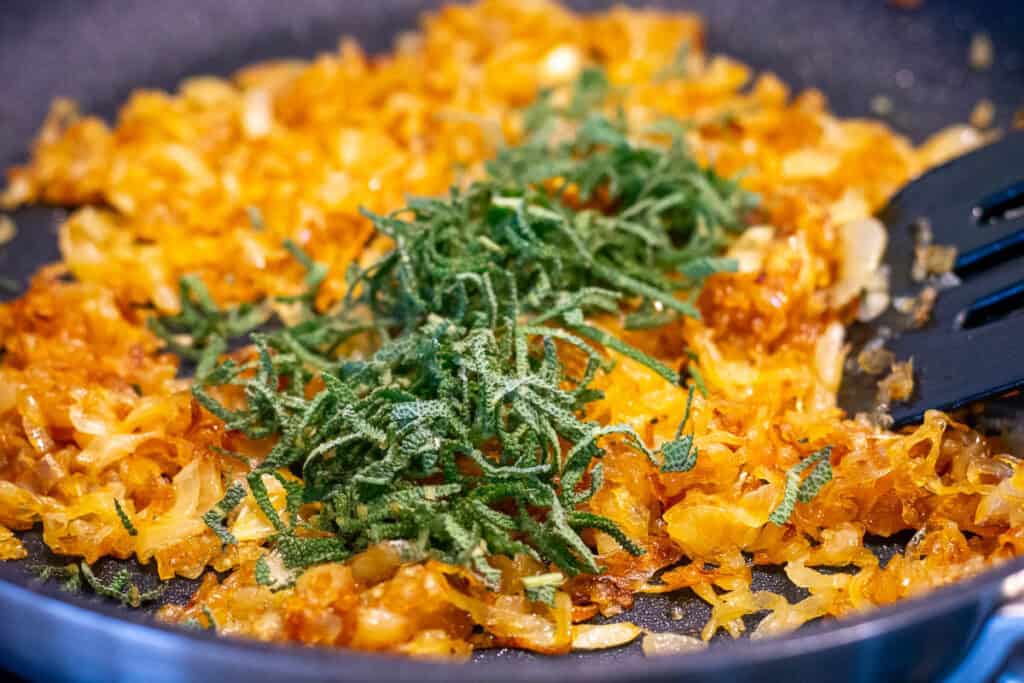
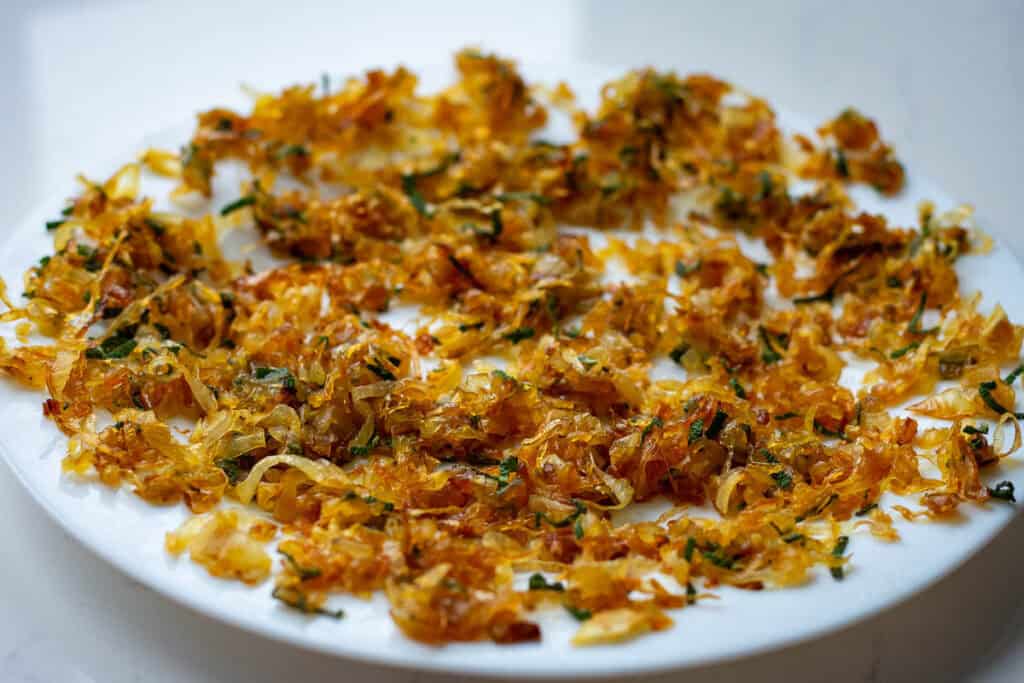
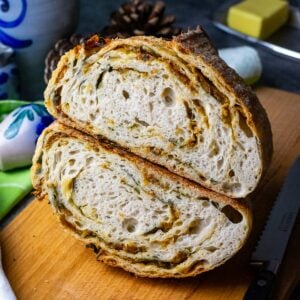
Low and slow is the whole trick. The onions go from translucent to golden, and finally to a deep, even amber, soft enough to squash with a spoon. That's jammy. Crisp, dark edges mean the heat is too high, and those bits will taste bitter in the bread.
When the pan catches, add a splash of water and scrape up the brown layer on the bottom. That's flavour, not mess.
Then let them cool completely. Warm onions speed up fermentation and weaken the dough just as you're asking it to carry them.
Mix the Dough and Do the Coil Folds
Don't panic when the dough feels firm after mixing. It's meant to. The onions bring plenty of moisture, and by the end of bulk the dough will be much softer.
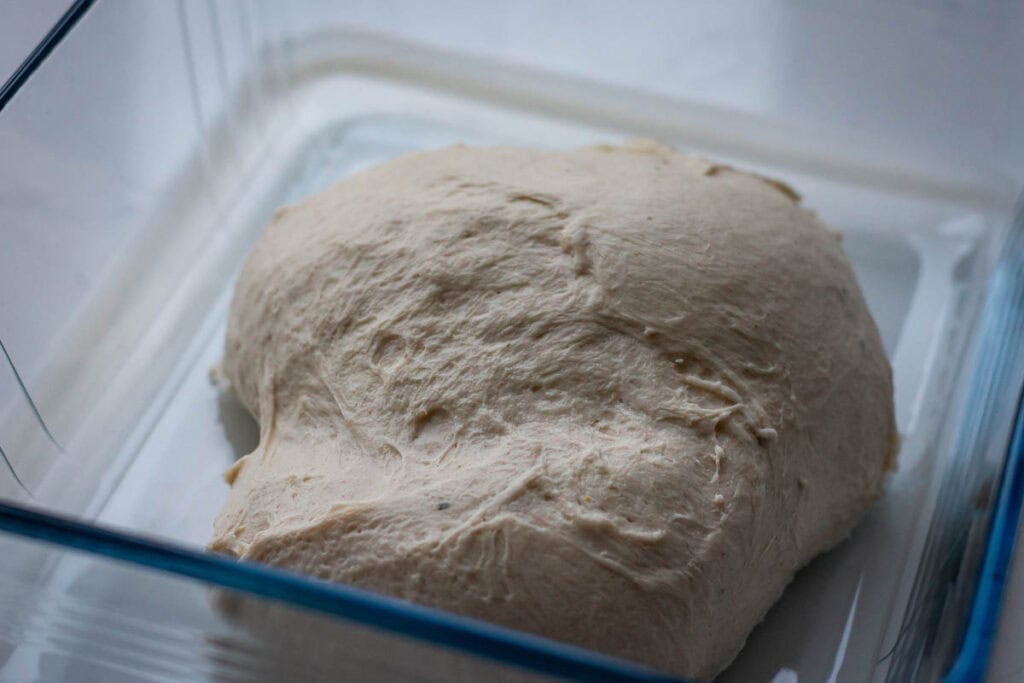
To coil fold, lift the dough from the middle with wet hands, let the ends tuck underneath, rotate and repeat. By the third set, the dough should hold a rounded shape, look smooth on top and stretch without tearing. If it still tears easily, give it one more set before you laminate.

FINISH Bulk Fermentation
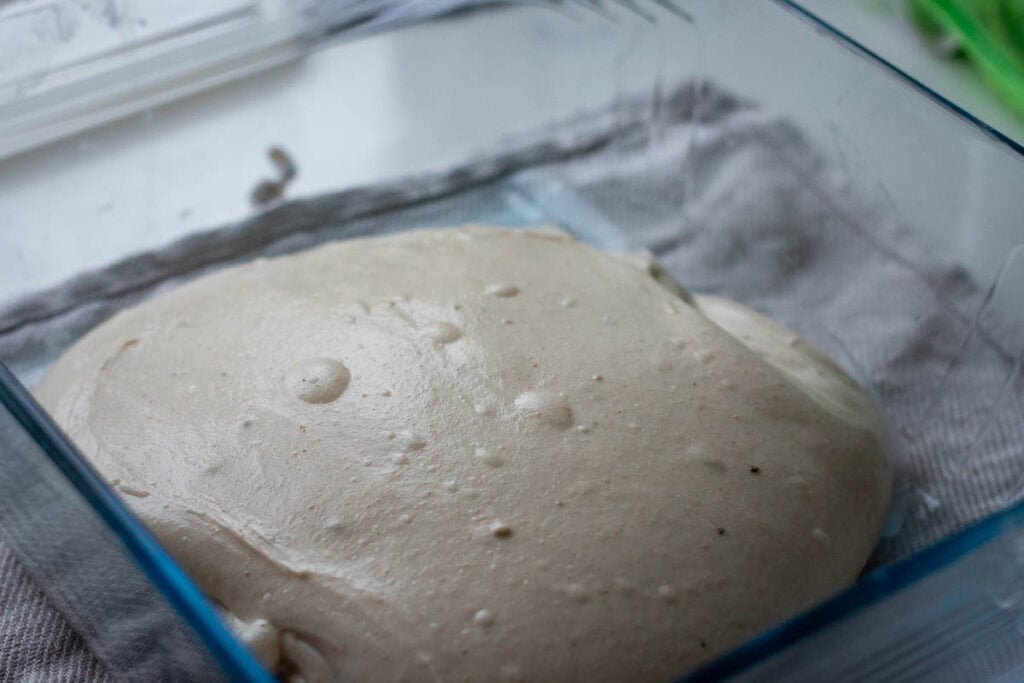
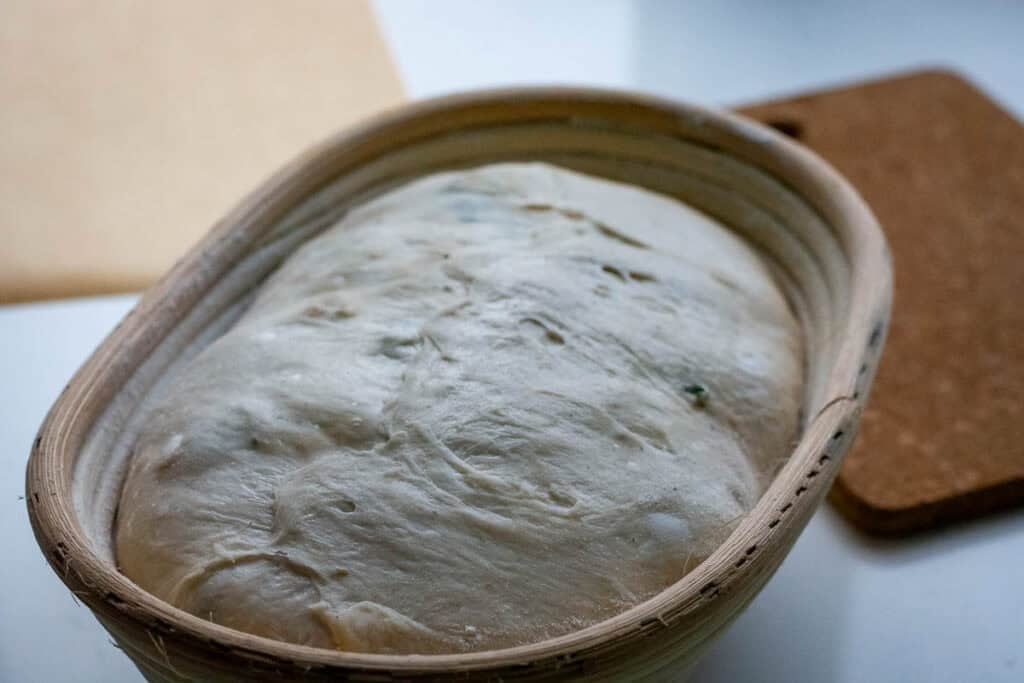
Aim for a 50-75% rise, not doubled. Push it to double and you'll get a flatter loaf with a tighter, stickier crumb.
A straight-sided container with a strip of tape at the starting level makes the rise easy to read. Ready dough is domed, slightly jiggly when you shake the container, and has bubbles at the sides.
Under-proofed dough looks dense and flat-topped, with very few bubbles. Over-proofed dough looks slack, spreads when you tip it out, and may have large bubbles popping on the surface.
Shape a Battard (or boule) With Mix-INs
Laminate in the Onion and Sage
Laminating Sourdough is the stage that makes or breaks this loaf.
Stretch the dough out on a lightly wet or floured worktop, working gently from the middle outwards.
Spread the onions properly. Pull any clumps apart with your fingers so they sit in a thin, even layer. A thick clump of wet onion stops the dough around it baking through, and that's where gummy, doughy pockets in the finished crumb come from.
As you roll the battard up, tuck any exposed onion back inside. Anything left on the surface will scorch in a very hot oven long before the loaf is done.
Good tension looks like a smooth, taut skin, and the shaped loaf holds itself up rather than slumping. If the surface tears as you roll, you're pulling too hard. Ease off and use the worktop's grip to do the work.
See the video below or in the recipe card to see how I incorporate onions and sage into this loaf.
Day 2
Score, Bake and Cool
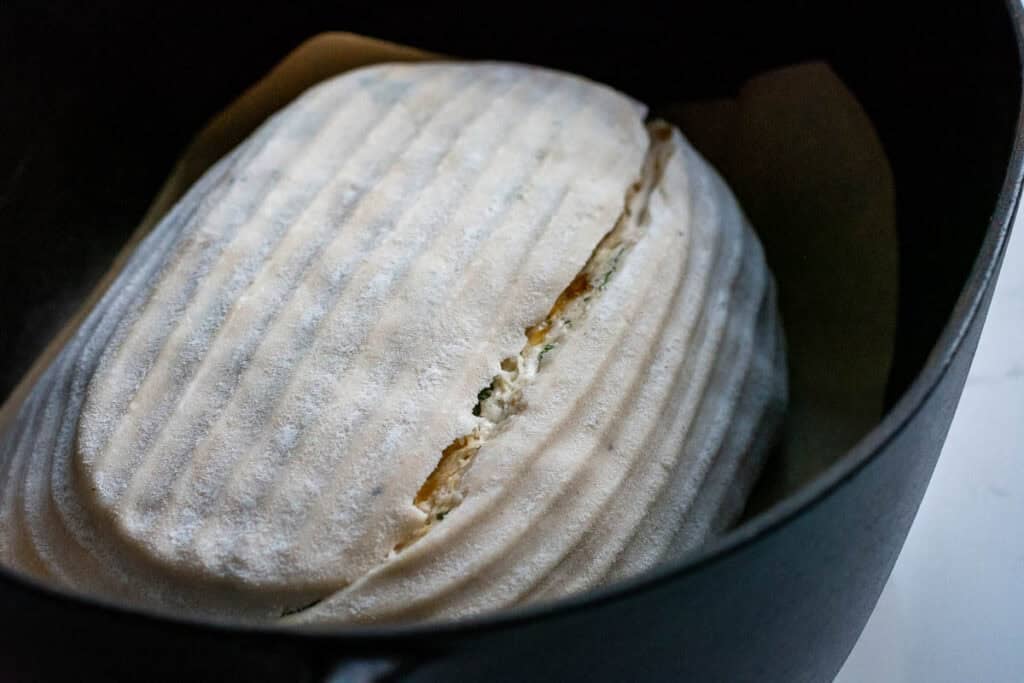
Bake straight from the fridge. Cold dough scores more cleanly and holds its shape better as it goes into the Dutch oven.
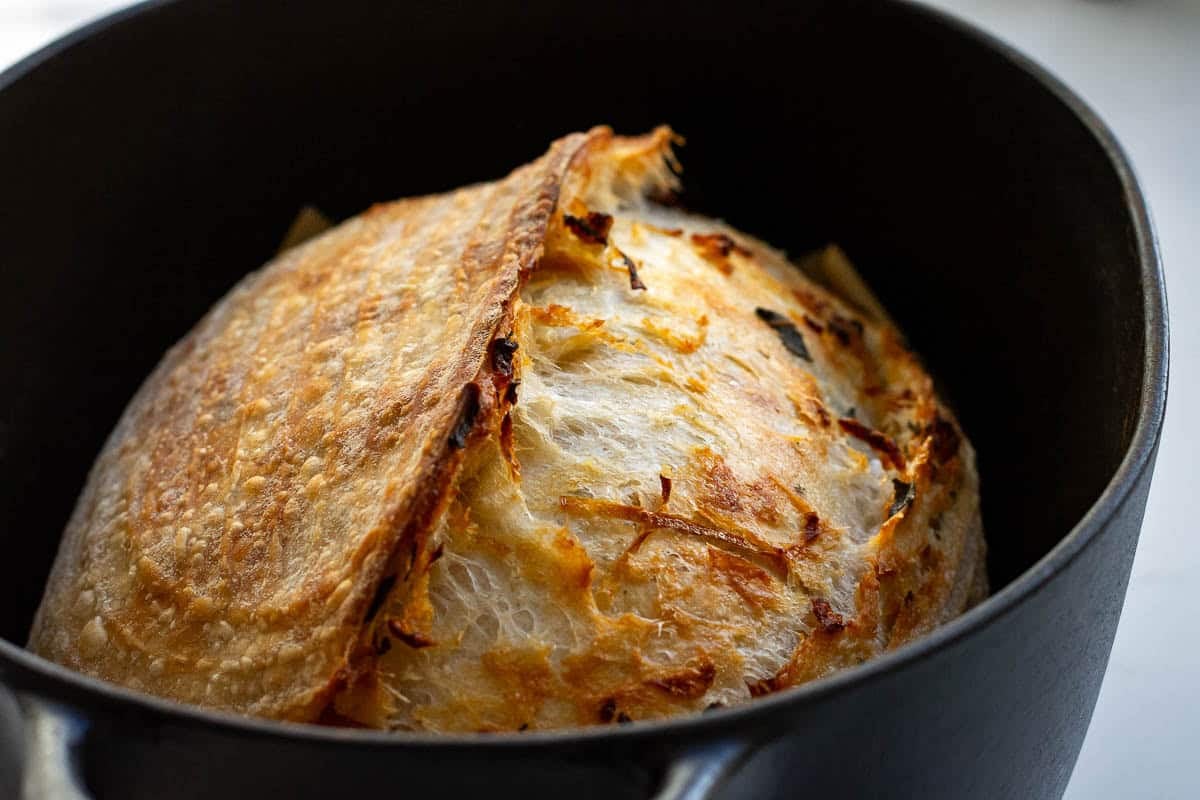
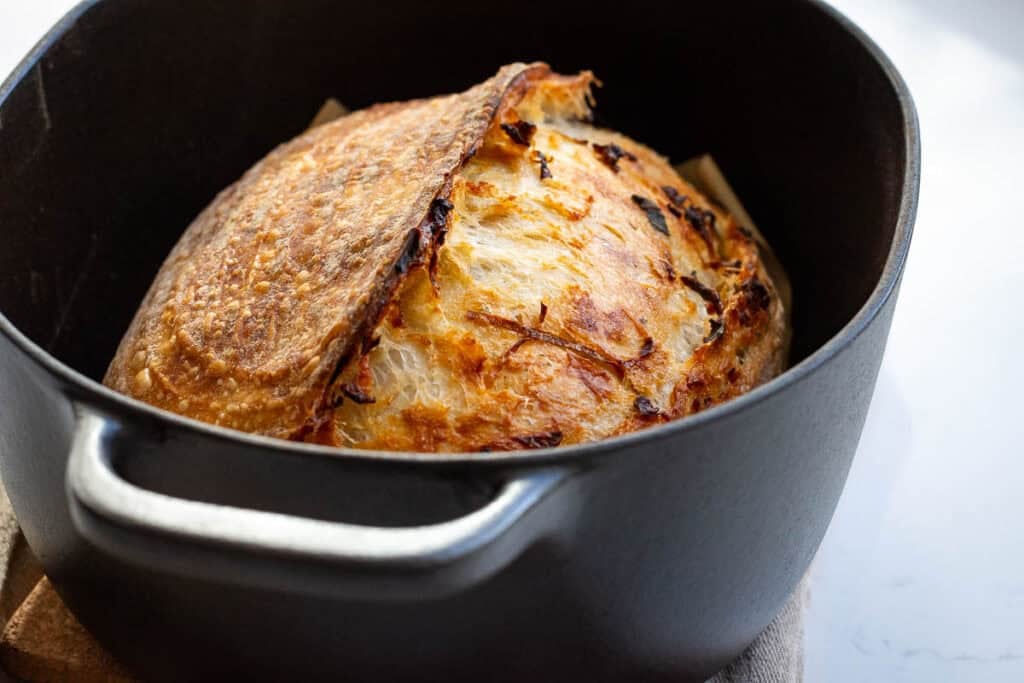
We bake sourdough in a lidded Dutch Oven for the full duration. What is more, the oven drops to 200°C / 400°F for the final stage because the onions add sugar, and sugar browns fast. At full heat, the exposed onion would go too dark before the middle is cooked.
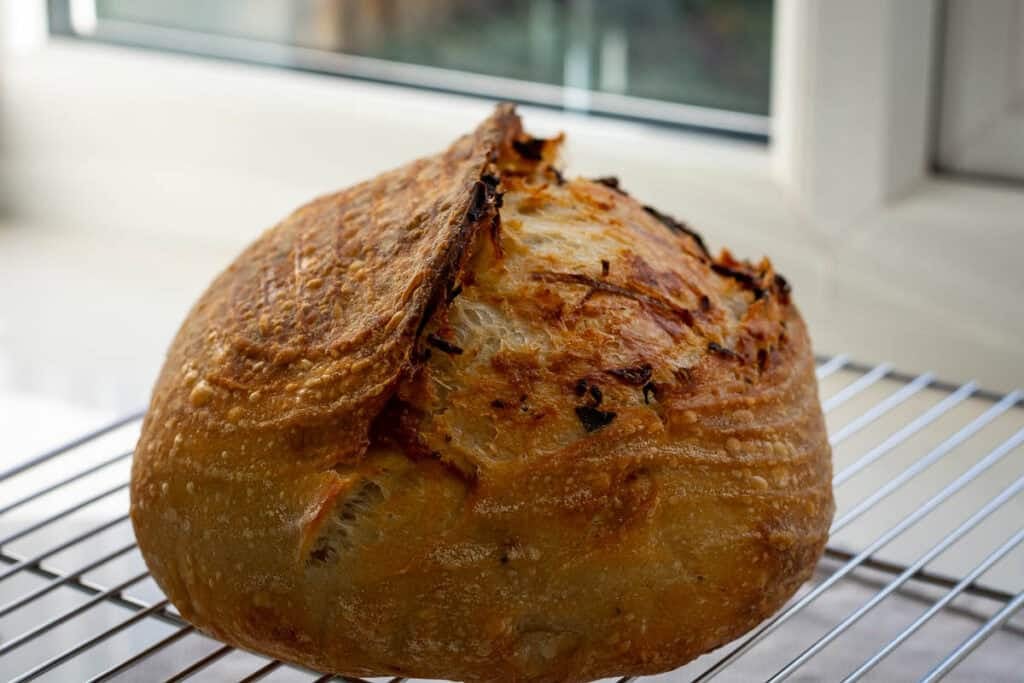
Then wait the full 2 hours. The crumb around the onions is still setting as it cools, and cutting early is the most common reason this loaf looks gummy even when the bake was spot on.
Tips For Success
🧅 Make a double batch of onions. They're the slowest part of the recipe and freeze well in 150g portions. That's the next loaf sorted, or a very good cheese on toast.
🌡️ Adjust for your kitchen. At the warm end of 21-27°C (70-81°F), bulk can be done in closer to 3 hours. In a cool kitchen, expect the full 4 hours or longer.
🔪 Use a serrated knife and saw gently. Pressing straight down squashes the soft crumb around the onions.
Variations
- American stuffing version: swap about half the raw sage for fresh thyme leaves, and sweat a finely diced celery stick with the onions. Weigh out 150g of the onion and celery mix together.
- Christmas version: laminate in 50g toasted, chopped chestnuts along with the onions.
- Cranberry: add a handful of dried cranberries during lamination for little sharp-sweet pops, the same pairing as my Easy Sourdough Stuffing Balls With Cranberries.
- Cheesy: if you want cheese in there, go straight to the Caramelised Onion and Cheddar Sourdough Bread, which is built for it.
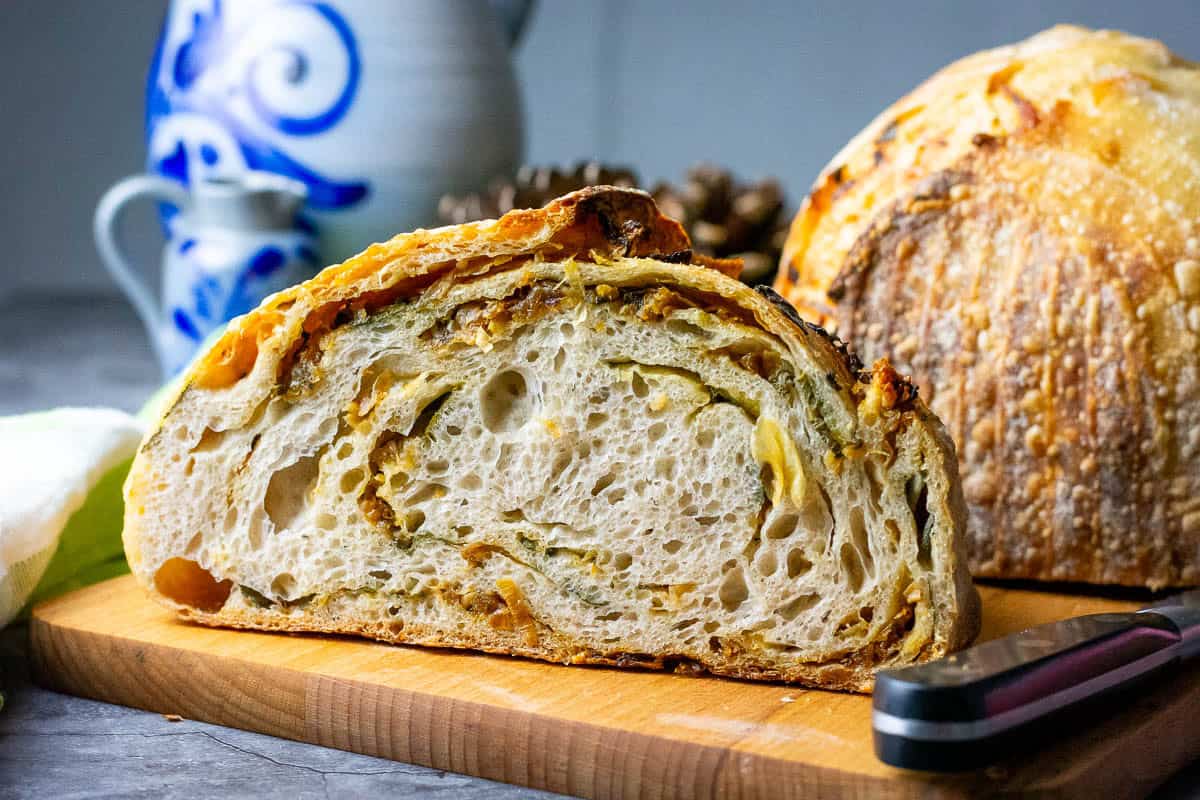
What To Serve With Stuffing Sourdough Bread
Put it on the Thanksgiving or Christmas table, with a dish of salted butter. The next day, it makes the leftover turkey sandwich of your dreams (turkey, cranberry sauce, a bit of gravy if you're brave).
It's also very good dunked into Celeriac Soup With Brown Butter, Crispy Sage and Hazelnuts, or cubed and toasted into croutons for a Christmas Leftover Caesar Salad With Homemade Dressing.
Can You Make Stuffing With Stuffing Bread?
Yes, and it's the best use for the last third of the loaf. Leave it out for a day to go stale, then cut it into cubes. Toss with melted butter, beaten egg and enough warm stock to moisten without going soggy, then bake until crisp on top.
The sage, onion and pepper are already in the bread, so go light on extra herbs, and taste your stock before adding salt.
For something you can pass round the table, my Easy Sourdough Stuffing Balls With Cranberries work well with this loaf. Just cut back on the onion and herbs, since the bread is already doing that job.
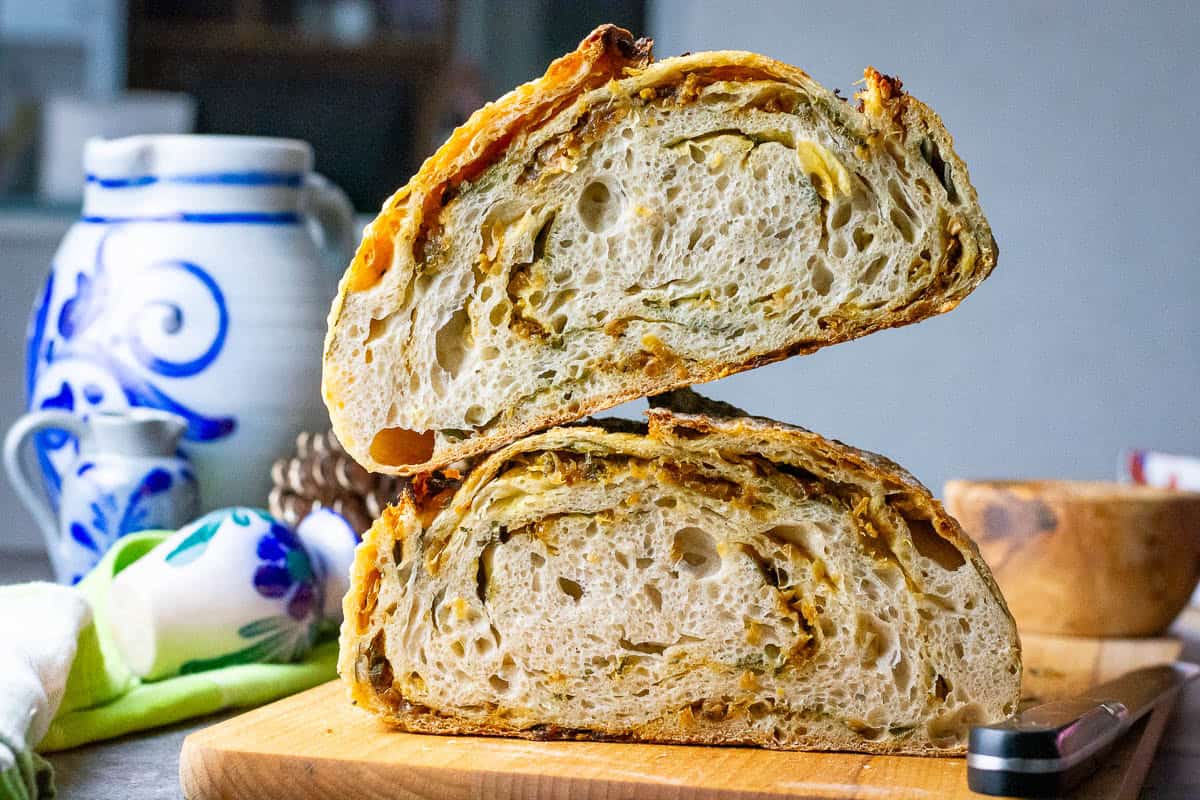
Recipe FAQs
Yes. Mix everything by hand until there's no dry flour left, then rest the dough for 30 minutes. Do 4 sets of coil folds instead of 3 to make up for the shorter mixing time, and carry on with the lamination as written. The dough will feel a bit shaggier at first, but the folds build the strength it needs.
You can, but both are sweeter and wetter than homemade onions. Shop-bought caramelised onions are the better option. Drain off any liquid and start with around 100g rather than 150g. Chutney has vinegar and more sugar, so the tang takes over and the crust browns much faster. If you use it, keep a close eye on the uncovered bake and expect a sweeter loaf that tastes less like stuffing.
Yes, you can swap up to 20% of the bread flour (100g) for wholemeal. Wholemeal absorbs more water, so add an extra 10-15g of water when mixing. Going much higher than 20% makes the dough weaker, which this loaf can't afford when it's already carrying 150g of wet onions.
A boule works perfectly. Shape it round, proof it in a round banneton and bake it in a round Dutch oven at the same temperatures and times. For a loaf tin, shape it into a log and proof it in a greased 900g (2lb) tin. You'll get tidier sandwich slices, but a softer, less crackly crust.
How To Store Stuffing Sourdough Bread
Keep it at room temperature, cut side down on a board or in a bread bag, for 2-3 days. The moisture from the onions means it doesn't last quite as long as a plain loaf. Don't put it in the fridge, because bread goes stale faster in the cold. For longer storage, slice it and freeze for up to 3 months, then toast the slices straight from frozen.
More Sourdough Recipes To Try
If onions in dough are your thing, the French Onion Sourdough Focaccia is the obvious next bake. For something autumnal without the onions, try my Sourdough Pumpkin Focaccia With Herbs De Provence. You can find a bunch of sourdough recipes with inclusions below:


LOVE BAKING SOURDOUGH WITH ME?
You can now add Somebody Feed Seb as a preferred source on Google. It only takes a tick box, and tells Google you'd like to see more of my recipes when relevant.
Sage and Onion Sourdough Bread (Stuffing Sourdough Bread)
Equipment
- Stand mixer with dough hook (or a big bowl and your hands)
- Banettone basket
- Dutch oven or large lidded casserole
- Bench scraper, lame or sharp knife
Ingredients
For the caramelised onions
- 500 g brown onions about 3 medium, thinly sliced
- 25 g unsalted butter
- 1 tablespoon olive oil
- Pinch of salt
- 4 g fresh sage leaves about 10 leaves, finely chopped
For the dough
- 500 g strong bread flour 12% protein minimum
- 10 g salt
- 1 g freshly ground black pepper (about ½ tsp)
- 300 g water
- 160 g active sourdough starter 100% hydration
Mix-ins
- 150 g caramelised onions cooked weight, fully cooled
- 6 g fresh sage leaves about 15 leaves, roughly chopped
Instructions
DAY 1:
Feed Sourdough Starter:
- First thing in the morning, feed your starter and leave it at 21-27°C (70-81°F) for about 4 hours, until doubled, bubbly and domed.
Make The Onions
- Melt the butter with the olive oil in a large frying pan over medium-low heat. Add the onions and a pinch of salt and stir to coat.
- Cook for 40-50 minutes, stirring every 5 minutes or so. If they start catching, add a splash of water and scrape up the sticky bits. You want them deep golden brown, soft and jammy, not crisp.
- Stir in the 4g finely chopped sage for the last 2 minutes so it cooks in the butter. This is the bit that makes it smell like Christmas stuffing.
- Tip onto a plate, spread out and cool completely. Weigh out 150g. Cold onions are non-negotiable, because warm ones will speed up fermentation and turn the dough slack. If you have extra, keep it for toast.
Mix The Dough
- Add the flour, salt and black pepper to the bowl of your stand mixer and stir briefly.
- Add the water and starter. Mix with the dough hook for 10-15 minutes, until the dough is smooth and comes away from the sides of the bowl. It will feel quite firm at this point. The onions loosen it later.
- Cover and rest for 30 minutes.
Coil Folds and Bulk Fermentation
- Do 4 sets of coil folds, 30 minutes apart, keeping the dough covered between sets.
- Put the dough back in a lightly oiled bowl, cover it, and leave it at 21-27°C (70-81°F) for 3-4 hours. It's ready when it has grown 50-75%, has a domed, slightly jiggly surface and shows bubbles at the sides of the bowl.
Shape, Add Mix-Ins And Cold Retard
- Tip the dough onto a lightly floured or wet surface and stretch it out into a rectangle, pulling gently from the middle outwards.
- Scatter ⅔ of the onions and ⅔ of the raw sage over the surface. Pull any clumps of onion apart as you go, because big wet pockets turn into gummy holes. Fold one side of the dough over into the middle. And the other side over - like a letter or a pamphlet.
- Add the last third of the onions and sage, then roll up from the short end to shape a battard. Pinch the ends together to seal in the filling and tuck in any onion poking out of the surface. See the video below for a visual illustration.
- Place seam-side up in a well-floured oval banneton. Stitch it, if it spreads in the basket. Put it in a plastic bag (or not, if your fridge doesn't tend to dry the dough out) and refrigerate at about 4°C (39°F) for 12-18 hours.
DAY 2:
- Put the Dutch oven in the oven and preheat to 240°C (465°F).
- Turn the dough out onto baking paper. Score one long, confident slash about 1cm deep at a 30-45° angle down the length of the loaf.
- Lower it into the hot Dutch oven, put the lid on, and bake for 40 minutes.
- After 40 minutes, reduce the oven to 200°C (400°F), and bake for another 12-15 minutes. Do not remove the lid (you can remove it to take a peek, but place it back on to continue baking). The sugar in the onions browns the crust faster than on a plain loaf, and they will burn if you bake this loaf uncovered. If you have a thermometer, the inside should read 96-98°C (205-208°F).
- Cool on a wire rack for at least 2 hours before slicing. Onion-heavy crumb is still setting as it cools.
Video
Notes
Nutrition


Leave a Reply