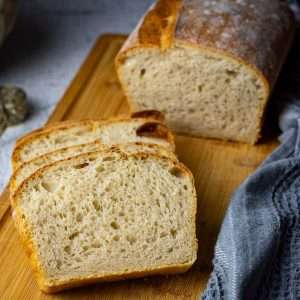
Sourdough Bread Baked In A Loaf Pan
Baking sourdough in a loaf pan might just become your new favourite way to bake bread! Picture this: a perfectly risen loaf, with a golden brown top and a beautiful crust that’s as satisfying to look at as it is to slice. Whether you're new to sourdough or simply want a reliable method, this loaf pan sourdough bread recipe is a guaranteed winner every time!
Equipment
- Dough Scorer optional
Ingredients
- 400 g strong bread flour
- 8 g salt
- 220 - 230 ml water
- 160 g active sourdough starter 100% hydration
Instructions
Step 1: Feed Your Sourdough Starter
- First thing in the morning, feed your sourdough starter. I typically feed 70g of my starter in a ratio of 1 part starter:1 part water:1 part flour. This simply means that I mix 70g of starter with 70g water and 70g flour. Scoop the mixture into a clean jar, and leave it in a warm spot (ideally, (21-27°C)), semi-covered for 4 hours. Your starter should at least double in volume in this time. If it doesn't, it may need a couple of good feeds before it's fit for purpose.
- I use 160g of active starter for baking and feed the remaining 50g before storing it for the future.
Step 2: Mixing The Dough
- Once the sourdough starter is active and bubbly (and at least doubled in volume), mix the dough. I use a stand mixer for this. Simply mix the flour and salt in the bowl of a stand mixer. Then add the water and sourdough starter. Run the mixer, fitted with a dough hook attachment for 10 minutes, until your dough is smooth and elastic. It does not need to pass the windowpane test just yet (the gluten will continue developing when we fold the dough during the bulk fermentation period).
Step 3: Folds and Bulk Fermentation
- Scoop the dough into a large bowl, cover with a damp kitchen towel or plastic wrap and leave it in a warm place (21-27°C) for 30 minutes.
- After 30 minutes, with cold wet hands, perform the first set of coil folds. Simply lift the bread dough with both hands from the sides and tuck it under to form a coil (video below). Rotate the bowl a quarter turn and coil again. Cover the bowl again, and let the dough rest for 30 minutes again.
- You should repeat the process every 30 minutes until you have done 4-6 sets of coil folds. Your dough will spread less with every set of folds, and by the end of it, you will have a much less sticky, very soft and elastic dough that has blisters on top of the dough.
- Once all the folds have been completed, cover the dough and let the dough rise at warm room temperature for 2-3 hours to finish bulk fermentation. Your dough should just about double its original size. If you are using a see-through glass bowl for bulk fermenting, you should see a lot of activity and bubbles forming at the base and sides of the bowl.
Step 4: Shaping and Second Proof
- Prepare your loaf pan by greasing it with butter and dusting it with a little flour (this prevents the dough from sticking, even if your loaf pan is non-stick).
- At the end of bulk fermentation, using a bowl scraper, scoop the dough onto a lightly floured surface. Try and make sure that the smooth top of the dough (the side that is not intact with the bowl) is placed on the floured work surface. Stretch the dough out a little into a rectangle, then fold the bottom third into the middle. Then fold both sides over like you're folding a tortilla wrap. Finally, roll the dough away from you into a tight log. You may need to stretch your rolled dough slightly to the length of your loaf pan.
- Place the sourdough roll seam side down into the prepared loaf tin. Cover it with a shower cap or a make shift cover made from a large ziplock bag. Make sure the bag does not touch the surface of the dough - you don't want it to stick.
- Place the loaf in a warm spot for 2-3 hours to proof again.
Step 5: Cold Proof (Optional)
- Place the covered loaf in the fridge overnight (or up to 36 hours). If you are short on time, you can place it in the fridge for 2-3 hours. Not only will this step improve the flavour of your sourdough loaf, but the dough will have time to firm up. This, in turn, makes it a lot easier to score, if you choose to do so. Having said that, if you want to bake your sourdough immediately after the second proof, you can!
Step 6: Scoring and Baking
- Preheat the oven to 200° C. Place an ovenproof dish full of boiling water on the bottom shelf of your oven to create steam.
- Take the sourdough out of the fridge and carefully uncover it.
- Lightly dust the top with flour, then score the dough in one swift motion. Whilst scoring is not necessary, it helps the trapped steam escape in the oven. Skipping the scoring might mean, that your dough will tear on top (or on one side) when baking.
- Bake sourdough for 40-45 minutes.
- Once baked, leave the loaf in a pan for 5 minutes, then turn your loaf of bread out onto a wire rack and leave to cool completely to room temperature before slicing.
Nutrition
Calories: 1590kcalCarbohydrates: 321gProtein: 52gFat: 7gSaturated Fat: 1gPolyunsaturated Fat: 3gMonounsaturated Fat: 1gSodium: 3122mgPotassium: 401mgFiber: 11gSugar: 1gVitamin A: 8IUCalcium: 69mgIron: 4mg
Tried this recipe?Let us know how it was!