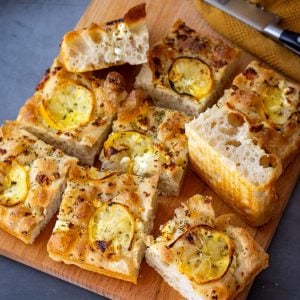
Sourdough Focaccia With Feta and Lemon
Golden, sun-drenched Sourdough Focaccia With Feta brings all the flavours of a Mediterranean summer straight into your kitchen. This sourdough lemon feta focaccia is soft and airy with a chewy crumb, topped with briny feta cheese, fragrant herbs and delicate slices of lemon that mellow and caramelise in the oven. It’s bright, savoury, just a little sweet and the kind of bake that feels right at home on a warm table with good olive oil and even better company.
Ingredients
- 260 g strong bread flour with at least 12% protein content
- 180 ml water
- 110 g active sourdough starter 100% hydration
- 5 g salt
- 5 g granulated sugar or honey
- 25 ml olive oil
Toppings:
- 80-100 g feta crumbled or small cubes
- ½ lemon very thinly sliced, seeds removed
- 1 teaspoon chopped thyme or rosemary leaves
- olive oil for drizzling
- a small pinch of sea salt
After Baking (optional):
- 1-2 teaspoon honey lightly drizzled
Instructions
DAY 1
- First thing in the morning, feed your sourdough starter and leave it in a warm spot to at least double in volume. We typically feed our starter in a ratio of 1 part starter: 1 part water: 1 part flour, and it doubles (or even triples) within 4 hours.
Fermentolyse and Mixing The Dough
- In the bowl of a stand mixer, combine flour, water and active sourdough starter. Mix the dough in a stand mixer fitted with a dough hook attachment for a few minutes on low speed, until the flour is hydrated. Cover the bowl with a damp tea towel and leave the dough to fermentolyse (a type of sourdough autolysis where sourdough starter is added too) for an hour.
- After an hour, scatter the salt and sugar (or honey) on top of the dough. Drizzle the olive oil all over, and using your hands, squish the salt and oil into the dough, aiming to distribute it evenly.
- TIP: Don't be tempted to just mix the oil in by running the stand mixer – the dough will split, separated by oil layers.
- Once incorporated, run your mixer on medium speed for 10-12 minutes, until you have a very smooth and elastic dough. It will be wet, but should start gathering around the dough hook attachment.
Coil Folds, Bulk Fermentation, Cold Proof
- Scoop the dough into a lightly oiled bowl (we like to use a heavy shallow dish – it helps with coil folds later). Cover the dough with a damp tea towel or cling film (plastic wrap) and leave it in a warm spot for 30 minutes.
- Over the next 3 hours, at 30-minute intervals, perform a set of coil folds, using wet hands.
- After all 6 sets of coil folds are completed, cover the dough and let it finish its bulk fermentation undisturbed for 1.5-3 hours, depending on the temperature of your kitchen.
- Place the dough in the refrigerator for 8-24 hours (or simply overnight).
DAY 2
- The next day, line a baking tray (approx 9x9-in/ 23x23cm) with parchment paper or, if using a non-stick pan, brush it with olive oil.
Second Rise
- Take the dough out of the fridge and very carefully transfer it into the prepared baking tray, trying not to deflate it too much. Stretch it out into the corners of the baking dish.
- Cover it again and leave it in a warm spot to proof for another 1-2 hours. It will increase in volume, puff up and have very noticeable blisters across the surface.
Topping and Baking
- Preheat the oven to 220°C (430°F).
- Sprinkle finely chopped herbs and feta across the surface of the dough.
- Oil your fingers and dimple the toppings into the dough, pressing deep down to the base of the pan.
- Lay the thinly sliced lemon slices on top (slice the lemon as thinly as possible. If your lemon has a thick or bitter pith, you can halve the slices or remove some of the pith).
- Drizzle with a little olive oil and sprinkle a little sea salt (not too much - feta is already salty!).
- Bake the focaccia for 20-22 minutes.
- Once baked, drizzle lightly with honey.
- Cool it for at least 20 minutes before slicing. Best enjoyed slightly warm or at room temperature on the day it is baked.
Video
Nutrition
Calories: 168kcalCarbohydrates: 25gProtein: 5gFat: 5gSaturated Fat: 2gPolyunsaturated Fat: 1gMonounsaturated Fat: 2gCholesterol: 8mgSodium: 319mgPotassium: 43mgFiber: 1gSugar: 1gVitamin A: 40IUVitamin C: 3mgCalcium: 51mgIron: 0.4mg
Tried this recipe?Let us know how it was!