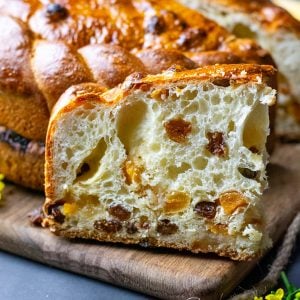
Sourdough Paska (Ukrainian Sourdough Easter Bread)
Nothing says Easter quite like a tall, golden loaf of Sourdough Paska sitting proudly on the table. Rich with butter, eggs, dried fruit and the gentle tang of natural fermentation, this traditional sourdough Easter bread is both celebratory and comforting — the kind of bake that fills the kitchen with warm, festive aromas. For many families across Eastern Europe, baking paska marks the arrival of the Easter holiday. It’s not just bread; it’s a symbol of renewal, celebration and the joyful arrival of spring.
Ingredients
- 320 g strong white flour with at least 12% protein content
- ⅛ teaspoon ground cardamom optional
- 40 g granulated sugar
- 5 g salt
- 160 g active sourdough starter 100% hydration
- 100 ml milk
- 2 eggs medium
- 100 g butter softened + extra for greasing
- 100 g raisins or sultanas
- 80 g dried apricots chopped
- 50 g marzipan cut into small cubes
For Egg Wash:
- 1 egg yolk
- 1 tablespoon milk
Instructions
DAY 1:
- First thing in the morning, feed your sourdough starter and leave it in a warm place to at least double in volume.
- In a bowl of a stand mixer, combine the strong flour, cardamom, sugar and salt.
- Add the milk, eggs and sourdough starter, and run your mixer, fitted with a dough hook attachment, for 5-6 minutes until a rough dough forms, but all the flour is hydrated.
- With your stand mixer still running, a little bit at a time, start adding butter, and mix for another 8-10 minutes, until you have a soft and elastic dough that passes the windowpane test.
- Scoop the dough into a clean large bowl, cover with cling film or a damp kitchen towel and let the dough rest in a warm spot for 30 minutes.
- After 30 minutes, perform a set of coil folds to redistribute the wild yeast, then cover and leave the dough for another 30 minutes. Repeat the coil folds three more times at 30 minute intervals.
- After all the folds have been completed, leave the dough undisturbed for 3-5 hours to finish bulk fermentation.
- In the meantime, grease an 18cm (7in) springform cake tin with butter and then line the bottom with baking parchment. Cut a long strip of baking parchment and line the sides, so the baking parchment sticks upwards from the tin by at least 10 cm. Use good quality, strong and sturdy baking parchment. You may use a larger tin for a wider, but less tall bake, if you wish. I wouldn't suggest using a tin larger than 23cm (9in) in diameter. Alternatively, you can make Ukrainian Paska in Panettone moulds.
- After bulk fermentation, cut off about ¼ of the dough, shape it into a ball and place it in a covered container. Place it in the fridge.
- Stretch the remaining dough out into a rectangle onto a work surface spritzed with water, without tearing it.
- Scatter a portion of the raisins, apricots and marzipan cubes over, and fold the left edge over, then the right edge over, forming a pamphlet.
- Scatter the rest of the ingredients over the long rectangle, and fold the top and then the bottom sides over (see step-by-step sourdough lamination process photos in the article).
- You are now left with a parcel of laminated dough with mix-ins. Place it in the prepared cake tin, cover loosely with a plastic bag to prevent the dough from drying out and place it in the fridge for 8-12 hours.
DAY 2:
- The next morning, take both the cake tin and the reserved dough without mix-ins out of the fridge.
- Divide the reserved ¼ of the dough into two and shape two long ropes, just a little longer than the circumference of your tin.
- Interweave the two strings like a rope, then place it in a circle alongside the inner edge of the cake tin on top of the dough already in it.
- Place the tin in a bag (to stop it drying out), make sure it is loosely covered and not touching the dough, and leave it in a warm spot for 2-4 hours until it increases in volume by about 60%.
- Preheat the oven to 180°C (350F).
- In a small bowl, mix egg yolk and a tablespoon of milk. Gently brush your Sourdough Easter Bread with the egg wash and place in the preheated oven for 40-45 min. Check the bread after 35 minutes to make sure it is not browning too quickly. Cover the top with foil if needed. Once baked, the internal temperature of the Ukrainian Paska should be around 88°C.
- Leave the bread to cool for a couple of hours before slicing! It is best eaten on the same day.
Nutrition
Calories: 265kcalCarbohydrates: 40gProtein: 6gFat: 10gSaturated Fat: 5gPolyunsaturated Fat: 1gMonounsaturated Fat: 3gTrans Fat: 0.3gCholesterol: 62mgSodium: 234mgPotassium: 227mgFiber: 2gSugar: 15gVitamin A: 591IUVitamin C: 0.4mgCalcium: 37mgIron: 1mg
Tried this recipe?Let us know how it was!