
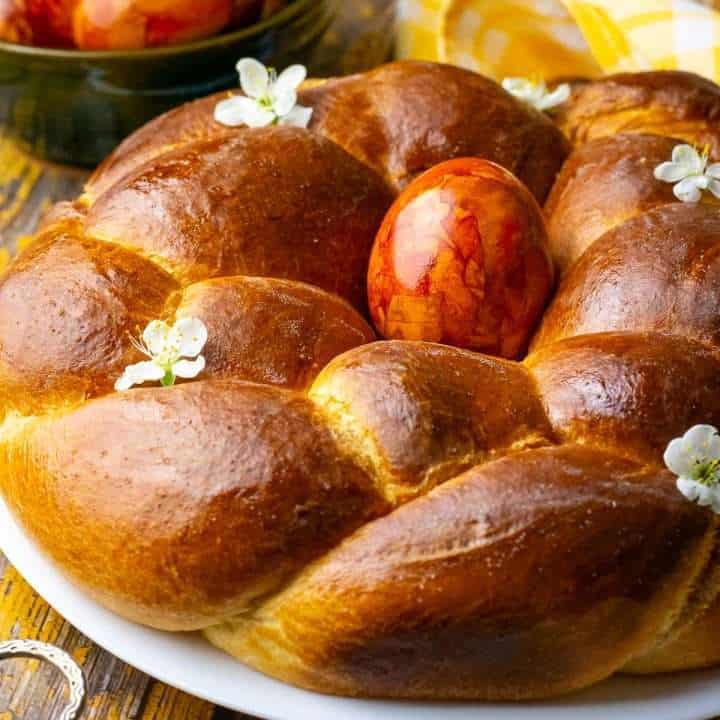
Nothing says Easter quite like a tall, golden Sourdough Paska sitting proudly on the table. Rich with butter, eggs, dried fruit and the gentle tang of natural fermentation, this traditional sourdough Easter bread is both celebratory and comforting - the kind of bake that fills the kitchen with warm, festive aromas. For many families across Eastern Europe, baking paska marks the arrival of the Easter holiday. It's not just bread; it's a symbol of renewal, celebration and the joyful arrival of spring.

Jump to:
As an Amazon Associate I earn from qualifying purchases, at no extra cost for you! Thank you!
What is a Ukrainian Paska?
Ukrainian Easter bread, known as paska bread, is a traditional enriched loaf baked for Easter Sunday in Ukraine and other parts of Eastern Europe. It's an egg-rich bread, often tall and cylindrical, decorated with ornamental crosses or dough braids on top.
Paska is closely tied to Orthodox Christian traditions. On Holy Saturday, families bring their baked paska to church as part of the blessing of an Easter basket, alongside Ukrainian Easter eggs and other festive foods. The bread is then served after the morning resurrection liturgy, marking the end of Lent.
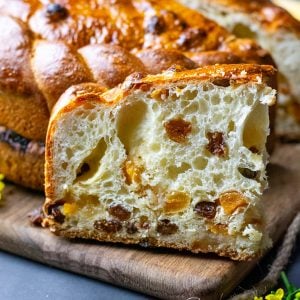
While recipes vary from family to family, most versions include flour, eggs, sugar, butter, milk and dried fruit. Some are made with commercial yeast (typically, fresh yeast), but using a sourdough starter gives the bread deeper flavour through natural fermentation - a slower process that produces wonderfully aromatic bread. Our version also includes marzipan cubes...

Ingredient Notes and Variations
- Strong white flour. Use strong white flour (around 12% protein). This enriched dough needs structure to support the tall loaf.
- Cardamom. Just a pinch adds subtle warmth. You can also use orange zest or vanilla extract for variation.
- Sugar. Traditional paska is only lightly sweet. If you prefer a sweeter loaf, increase the sugar slightly.
- Salt. Balances the sweetness and strengthens the dough.
- Active sourdough starter. Your sourdough starter should be bubbly and active. Natural fermentation gives the bread its complex flavour.
- Milk. Whole milk works best for richness. Warm milk (not hot) helps the dough rise comfortably.
- Eggs. Eggs enrich the dough and create the signature soft crumb typical of egg bread.
- Butter. Use softened butter so it incorporates smoothly into the dough.
- Dried fruit (raisins and apricots). Classic additions for paska bread. You can substitute with sultanas, dried cranberries, candied peel, or even chocolate chips for a modern twist.
- Marzipan cubes. Optional but delightful - they melt slightly into the crumb.
- Egg wash. A simple mixture of egg yolk and milk brushed over the top of the bread gives that beautiful golden brown finish.

Step-By-Step Method
1. Feed your sourdough starter
Early in the morning, feed your sourdough starter and leave it in a warm place until doubled. An active starter is essential for best results.
2. Mix the dough
In the bowl of a stand mixer fitted with a dough hook, combine flour, sugar, salt and cardamom.
Add milk, eggs and sourdough starter.
Mix on low speed until a sticky dough forms and the flour is hydrated.
3. Add butter gradually
With the mixer running, add softened butter a little at a time. Continue mixing until the dough becomes soft, elastic and passes the windowpane test.

Pro Tip: If the dough sticks to the sides of the bowl, resist adding extra flour - enriched dough is naturally soft.
4. First dough rest
Transfer the dough ball to a greased bowl, cover with plastic wrap or a tea towel, and leave in a warm place for 30 minutes.
5. Strengthen the dough
Perform coil folds (or stretch and folds) every 30 minutes for about two hours to strengthen the gluten structure.
6. Bulk fermentation
Leave the dough in a warm place for 3-5 hours until it shows a noticeable dough rise.
7. Prepare the baking tin
Line a springform baking pan with parchment paper, allowing extra height above the rim. Paska rises tall.
8. Lamination with fruit
Reserve ¼ of the dough and place it in a separate container (this will be used for the braid). Stretch the rest of the dough gently onto your work surface. Scatter half the dried fruit and marzipan cubes.
Fold the dough like a letter, add the remaining fruit, and fold again to form a parcel.

9. Cold proof
Place the dough into the prepared pan, cover with plastic wrap and refrigerate overnight. Place the plain dough in the fridge, too.
Pro Tip: This cold proof improves flavour and makes the dough easier to handle the next day.

10. Create the decorative braid
The next day, remove the dough and the reserved portion from the fridge. Shape the reserved dough into a long rope, twist it into a braid and place it around the top edge of the bread.


11. Second rise
Leave the dough in a warm place for 2-4 hours until it expands by about 60%.
12. Egg wash and bake
Mix egg yolk and milk in a small bowl. Brush the top of the bread with the egg mixture.

Bake in a preheated oven at 180°C until golden brown, about 40-45 minutes.
Pro Tip: If the top browns too quickly, cover loosely with foil.
13. Check doneness
The internal temperature should reach about 88°C when measured with an instant-read thermometer.
14. Cool completely
Transfer the bread to a cooling rack and allow it to cool fully before slicing.

Serving Suggestions
Traditionally, sourdough Ukrainian paska takes center stage on the Easter table. Thick slices are served alongside butter and soft cheeses.
Some families enjoy it simply with tea or coffee on Easter Sunday morning, while others serve it with festive dishes after church.
Because paska is an enriched dough, it pairs beautifully with lightly sweet toppings like honey or fruit preserves.
Toasted slices with butter are absolutely wonderful too the next day.

Storage and Leftovers
Store the cooled loaf at room temperature in a bread box or wrapped in a tea towel for up to three days.
For longer storage, slice the bread and freeze it in an airtight container or freezer bag. It freezes beautifully for up to three months.
If your paska begins to go stale, don't worry - there are plenty of delicious ways to use it:
- French toast
- Bread pudding
- Sweet Easter breakfast casserole
The good news is that enriched breads like paska retain their flavour even when repurposed.
More Easter Sourdough Recipes
If you love baking festive breads like sourdough paska, explore more Easter sourdough recipes below - from hot cross buns to other seasonal bakes perfect for the Easter holiday.


Sourdough Paska (Ukrainian Sourdough Easter Bread)
Ingredients
- 320 g strong white flour with at least 12% protein content
- ⅛ teaspoon ground cardamom optional
- 40 g granulated sugar
- 5 g salt
- 160 g active sourdough starter 100% hydration
- 100 ml milk
- 2 eggs medium
- 100 g butter softened + extra for greasing
- 100 g raisins or sultanas
- 80 g dried apricots chopped
- 50 g marzipan cut into small cubes
For Egg Wash:
- 1 egg yolk
- 1 tablespoon milk
Instructions
DAY 1:
- First thing in the morning, feed your sourdough starter and leave it in a warm place to at least double in volume.
- In a bowl of a stand mixer, combine the strong flour, cardamom, sugar and salt.
- Add the milk, eggs and sourdough starter, and run your mixer, fitted with a dough hook attachment, for 5-6 minutes until a rough dough forms, but all the flour is hydrated.
- With your stand mixer still running, a little bit at a time, start adding butter, and mix for another 8-10 minutes, until you have a soft and elastic dough that passes the windowpane test.
- Scoop the dough into a clean large bowl, cover with cling film or a damp kitchen towel and let the dough rest in a warm spot for 30 minutes.
- After 30 minutes, perform a set of coil folds to redistribute the wild yeast, then cover and leave the dough for another 30 minutes. Repeat the coil folds three more times at 30 minute intervals.
- After all the folds have been completed, leave the dough undisturbed for 3-5 hours to finish bulk fermentation.
- In the meantime, grease an 18cm (7in) springform cake tin with butter and then line the bottom with baking parchment. Cut a long strip of baking parchment and line the sides, so the baking parchment sticks upwards from the tin by at least 10 cm. Use good quality, strong and sturdy baking parchment. You may use a larger tin for a wider, but less tall bake, if you wish. I wouldn't suggest using a tin larger than 23cm (9in) in diameter. Alternatively, you can make Ukrainian Paska in Panettone moulds.
- After bulk fermentation, cut off about ¼ of the dough, shape it into a ball and place it in a covered container. Place it in the fridge.
- Stretch the remaining dough out into a rectangle onto a work surface spritzed with water, without tearing it.
- Scatter a portion of the raisins, apricots and marzipan cubes over, and fold the left edge over, then the right edge over, forming a pamphlet.
- Scatter the rest of the ingredients over the long rectangle, and fold the top and then the bottom sides over (see step-by-step sourdough lamination process photos in the article).
- You are now left with a parcel of laminated dough with mix-ins. Place it in the prepared cake tin, cover loosely with a plastic bag to prevent the dough from drying out and place it in the fridge for 8-12 hours.
DAY 2:
- The next morning, take both the cake tin and the reserved dough without mix-ins out of the fridge.
- Divide the reserved ¼ of the dough into two and shape two long ropes, just a little longer than the circumference of your tin.
- Interweave the two strings like a rope, then place it in a circle alongside the inner edge of the cake tin on top of the dough already in it.
- Place the tin in a bag (to stop it drying out), make sure it is loosely covered and not touching the dough, and leave it in a warm spot for 2-4 hours until it increases in volume by about 60%.
- Preheat the oven to 180°C (350F).
- In a small bowl, mix egg yolk and a tablespoon of milk. Gently brush your Sourdough Easter Bread with the egg wash and place in the preheated oven for 40-45 min. Check the bread after 35 minutes to make sure it is not browning too quickly. Cover the top with foil if needed. Once baked, the internal temperature of the Ukrainian Paska should be around 88°C.
- Leave the bread to cool for a couple of hours before slicing! It is best eaten on the same day.
Nutrition

Paska says
I made this and it turned out so beautifully. I've made lots of paska before but was looking to adapt to pure sourdough and this is a great recipe to do so. It came out flavorful, light and airy while still rich. Having patience through the long proofing cycles makes a huge difference. Thanks for this!
Ieva Greber says
That sounds like an absolute win — I’m so glad it turned out beautifully for you! Paska can be a bit of a test of patience, so it’s lovely to hear the long proof paid off.
Thanks so much for taking the time to share — it genuinely means a lot 😊