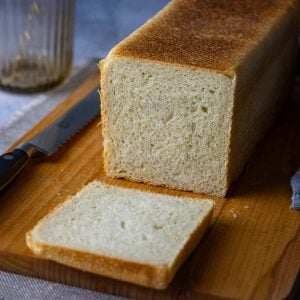
Sourdough Pullman Loaf (Sourdough Pain de Mie)
A soft, enriched sourdough loaf baked with the lid on in a Pullman pan, giving you perfectly square, even slices for sandwiches and toast.
Equipment
- Stand Mixer fitted with a dough hook attachment
- USA Pan Pullman loaf pan with lid, 23 x 10cm ( 9x 4 inches)
- Digital kitchen scale
- Instant-read thermometer (optional but recommended)
- Bench Scraper
Ingredients
- 390 g strong white bread flour with at least 12% protein content
- 240 g whole milk lukewarm
- 160 g active sourdough starter 100% hydration
- 40 g unsalted butter softened
- 35 g granulated sugar
- 9 g fine sea salt
- neutral oil or extra soft butter for greasing the pan
Instructions
Day 1
- First thing in the morning, feed your sourdough starter in the ratio of 1:1:1 and leave it in a warm spot for 4-5 hours to at least double in volume.
Fermentolyse and Mixing The Dough
- In the bowl of a stand mixer fitted with the dough hook, combine the bread flour, milk and active starter. Mix on low speed until no dry flour remains and the dough looks shaggy. Cover and rest for 30 minutes. This short autolyse hydrates the flour and cuts down mixing time later.
- Add the salt and sugar. Mix on low-medium speed for about 5 minutes, until the dough starts to come together and smooth out.
- With the mixer still running on low-medium, add the softened butter a tablespoon or so at a time, waiting until each addition is fully incorporated before adding the next. The dough will look greasy and like it's falling apart partway through, that's normal, keep the mixer going.
- Continue mixing until the dough is smooth, elastic and passes the windowpane test (stretch a small piece thin enough to see light through it without tearing), roughly 10-15 minutes once all the butter is in. Check the dough isn't overheating from the mixer, it should still feel cool to the touch, not warm.
Bulk Fermentation
- Scrape the dough into a lightly oiled bowl or container, cover, and leave to bulk ferment somewhere around 21-23°C for 6-8 hours. No stretch and folds needed, the dough hook has already done the gluten development. Look for about a 50% increase in volume and a puffy, jiggly feel rather than a specific size.
Shaping and Cold Proof
- Grease the Pullman pan and lid well. Turn the dough out, shape it into a tight log the length of the pan, and settle it into the tin seam-side down. Place the loaf in a plastic bag to prevent the skin from forming (lid off) and refrigerate overnight, 12-15 hours.
Day 2
Second Rise
- Remove the pan from the fridge and let the dough proof at room temperature until it sits 1-2cm below the rim of the pan, and is gently doming below the top edge of it. Depending on your kitchen, this can take 3-5 hours. Underproofed dough won't fill the corners of the pan, so don't rush this stage.
Baking
- Slide the lid on and bake at 190°C/375°F for 38-42 minutes.
- Slide the lid off partially and check the internal temperature reaches 94-96°C/201-205°F. Remove the lid carefully, there will be steam, and unmould the loaf onto a wire rack straight away.
- Cool completely, at least 2 hours, before slicing.
Notes
1. No Pullman pan? Use a standard 900g (2lb) loaf tin, uncovered for a domed top.
2. Sugar can be swapped 1:1 by weight for honey.
Nutrition
Calories: 2119kcalCarbohydrates: 359gProtein: 59gFat: 47gSaturated Fat: 26gPolyunsaturated Fat: 4gMonounsaturated Fat: 11gTrans Fat: 1gCholesterol: 115mgSodium: 3594mgPotassium: 761mgFiber: 10gSugar: 48gVitamin A: 1396IUCalcium: 366mgIron: 4mg
Tried this recipe?Let us know how it was!