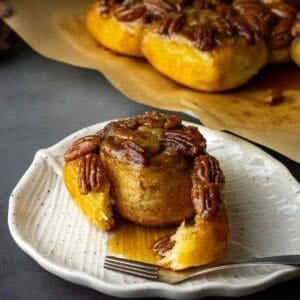
Sticky Sourdough Buns
Soft, enriched sourdough buns baked upside down over a buttery pecan caramel, so every bun gets flipped out sticky, glossy and studded with toasted pecans. Baked in a 9-inch square pan, these are the caramel-and-pecan answer to a cinnamon roll.
Equipment
- Stand mixer fitted with a dough hook (or knead by hand)
- 23x23cm (9-inch) square baking pan, high-sided
- Small Saucepan (for the caramel)
Ingredients
For the dough:
- 160 g active sourdough starter 100% hydration
- 320 g strong white bread flour with at least 12% protein
- 30 g granulated sugar
- 6 g (1 tsp) fine sea salt
- 100 g milk
- 2 eggs medium, room temperature
- 100 g unsalted butter softened and cubed
For the pecan caramel:
- 90 g unsalted butter
- 120 g soft light brown sugar dark brown works too, for a deeper, more molasses-y caramel
- 80 g maple syrup (or 80g golden syrup, see Notes)
- a pinch of fine sea salt
- 150 g pecan halves
For the cinnamon filling:
- 60 g unsalted butter very soft
- 100 g soft light brown sugar
- 2 teaspoon ground cinnamon
- a pinch of fine sea salt
Instructions
DAY 1:
- Feed your sourdough starter 4-6 hours before mixing, so it's active, doubled in size and domed on top.
Mixing The Dough
- In the bowl of a stand mixer fitted with the dough hook, combine the flour, sugar and salt. Add the milk, eggs and active starter. Mix on low speed for 5-7 minutes until you have a shaggy, sticky dough.
- Cover and rest for 10-15 minutes. This short rest hydrates the flour and makes the butter easier to work in.
- With the mixer running on medium speed, add the softened butter a few cubes at a time, letting each addition disappear before adding more. Keep mixing for 10-15 minutes until the dough is smooth and elastic and passes the windowpane test (stretch a small piece thin enough to see light through without it tearing).
Bulk Fermentation and Cold Proof
- Transfer to a lightly greased bowl, cover, and leave to bulk ferment at 20-24°C (68-75°F) for 4-6 hours, undisturbed. Enriched dough won't double here, look for a gentle 30-40% rise and a slightly domed, puffy surface.
- Cover tightly and refrigerate for 8-16 hours. The cold proof firms the butter and makes the dough far easier to roll out the next day.
Day 2 :
Caramel Sauce
- Make the caramel: melt the butter, brown sugar, maple syrup and salt in a small saucepan over medium-low heat, stirring until the sugar has dissolved and the mixture is smooth and glossy, about 3-4 minutes. Don't let it boil hard, you just want the sugar to dissolve and the mixture to start gently bubble around the edges of the pan.
- Pour the caramel into the base of a well-greased 23x23cm (9-inch) square pan, tilting so it coats the bottom evenly. Scatter the pecans over the caramel in a single even layer. Don't line the pan with parchment for this layer, you want the caramel to release cleanly when you flip it later.
Shaping
- Turn the chilled dough onto a floured surface and roll into a rectangle roughly 40x30cm.
- Spread the very soft butter over the dough right to the edges. Mix the brown sugar, cinnamon and salt together and scatter evenly over the buttered dough.
- Cut the dough into approx 4 cm wide strips, then roll each into a tight roll and place on the pecan caramel.
- Alternatively, roll up the uncut dough tightly from the long edge into a log. Pinch the seam to seal. Trim the uneven ends, then cut into 9 even buns (about 4cm thick) using a sharp knife or a length of unflavoured dental floss.
- Arrange the buns cut-side up on top of the pecan caramel in a 3x3 grid, with a little gap between each, they'll expand and meet as they proof.
Second Rise
- Cover loosely with oiled cling film and proof at 22-25°C (72-77°F) for 4-5 hours, until visibly puffy, expanded by around 50-75%, and the buns are touching.
- Near the end of proofing, preheat the oven to 190°C (375°F).
- Bake for 28-30 minutes until the buns are golden on top and the caramel is bubbling visibly at the edges of the pan. If the tops are colouring before the caramel's had time to fully bubble through, tent loosely with foil for the last 5-10 minutes.
- Let the buns cool for 5-15 minutes, checking as you go by slipping a blunt knife down the side of the pan to see the caramel at the base, as soon as it looks syrupy rather than liquid, flip straight away, any longer and it'll grab the pan and leave the caramel and pecans stuck to the base instead of on top of your buns.
Finishing
- Run a knife around the edge of the pan to loosen. Place a serving plate or tray upside down over the pan, then, holding both firmly together, flip the whole thing over in one confident motion. Lift the pan away. If a few pecans stay behind, just peel them off and press them back into place.
- Scrape any caramel left in the pan over the top of the buns. Serve warm.
Notes
Golden syrup swap: if you'd rather use golden syrup than maple syrup, swap it in at the same 80g and the caramel will still work, it just sets slightly firmer and stickier rather than saucy, since golden syrup holds less water than maple syrup. Either way, don't reduce the quantity when you swap.
Keep checking the caramel when the buns come out of the oven. Warm caramel is fluid; cooled caramel sets hard and will glue the buns to the pan. If it does set before you flip it, a very short blast back in a low oven (or on the hob under the pan, off the heat, briefly) will loosen it again.
Toast the pecans lightly in a dry pan for a few minutes before using, if you want a deeper, more roasted flavour, they're going into a hot oven but not directly toasted otherwise.
Storage: best eaten the day they're made, while the caramel is still soft and glossy. Keep any leftovers covered at room temperature for up to 2 days, warming gently in the oven before serving.
Nutrition
Calories: 607kcalCarbohydrates: 66gProtein: 8gFat: 36gSaturated Fat: 16gPolyunsaturated Fat: 5gMonounsaturated Fat: 13gTrans Fat: 1gCholesterol: 96mgSodium: 289mgPotassium: 197mgFiber: 3gSugar: 34gVitamin A: 781IUVitamin C: 0.2mgCalcium: 78mgIron: 1mg
Tried this recipe?Let us know how it was!