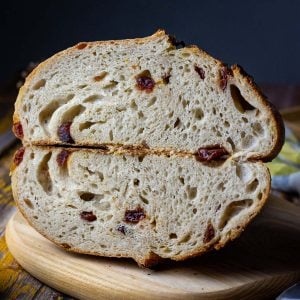
Cranberry Orange Sourdough Bread
Nothing smells more like winter than a loaf of Cranberry Orange Sourdough Bread cooling on the counter. Think tangy cranberries, bursts of fresh orange zest, and a beautifully golden crust that feels right at home on a Christmas morning table. This orange cranberry sourdough bread brings together sweet, sharp and fragrant flavours — perfect for the holiday season, gifting, or just brightening a cold day.
Equipment
- Bench Scraper
- Proofing Basket
- Razor Blade or Bread Lame
Ingredients
- 400 g strong bread flour with at least 12% protein
- 15 g (1 heaped tbsp) granulated sugar, or caster sugar
- 7 g salt
- 240 g water
- 160 g active sourdough starter 100% hydration
- 1 large orange or 2 small ones, zest and juice
- 100 g dried cranberries
Instructions
DAY 1
- First thing in the morning, feed the sourdough starter and leave it in a warm place (ideally between 21-27°C), loosely covered, for 4-5 hours. The starter should double in size by then. If it doesn't, it might need a few more good feedings to be ready. If it doesn't, head to our article Sourdough Starter Not Doubling Within 4 Hours. How To Fix It?
Mixing The Dough
- In a bowl of your stand mixer, combine flour, salt and sugar.
- Add the water and active sourdough starter. Run the stand mixer for 10-15 minutes until your dough is smooth and elastic. It does not need to pass the windowpane test just yet (the gluten will continue developing when we fold the dough during the bulk fermentation period).
Prepare Mix-Ins
- Zest your orange and keep the zest covered in a small bowl.
- Place the dried cranberries in a small bowl with the juice of an orange. You need enough juice just to submerge the cranberries. Cover and set aside until the lamination and shaping stage (at least 6 hours).
Bulk Fermentation and Coil Folds
- Scoop the dough into a large bowl, cover with a damp kitchen towel or plastic wrap (a.k.a. cling film) and leave it in a warm place (21-27°C) for 30 minutes.
- After 30 minutes, with cold wet hands, perform the first set of coil folds. Simply lift the bread dough with both hands from the sides and tuck it under to form a coil. Rotate the bowl a quarter turn and coil again. Cover the bowl again, and let the dough rest for 30 minutes again.
- Repeat the coil folds 3 more times. After the fourth coil fold, your dough should feel a lot less sticky and feel strengthened and elastic.
- Cover the dough and leave it to finish bulk fermentation for 2-3 hours.
Lamination and Shaping
- Drain the cranberries in a sieve pressing them down to squeeze out excess moisture.
- Once your sourdough has finished bulk fermentation, scoop it out onto a work surface dusted lightly with some rice flour. Stretch the dough out into a rectangle.
- Scatter ⅓ of the orange zest and ⅓ of orange-infused cranberries in the centre middle ⅓ of the dough, and fold one side over. Scatter ½ of the remaining mix-ins on the folded-over surface and cover them with the other side of the dough. Finally, scatter the remaining mix-ins across the long strip of dough and roll the dough tightly.
- Place the dough ball into a well-floured banneton basket (or any proofing basket alternatives). We recommend using rice flour for dusting your proofing baskets. The smooth side of the sourdough ball should be at the bottom, with the seam side up.
- Pinch the seam together with your fingers, if the dough starts spreading in the bowl to make sure the dough is tight. Sprinkle with some flour, and cover the dough with a clean fabric napkin or small lightweight tea towel.
- If your fridge tends to dry things out, place the proofing basket in a large plastic bag, but I find it unneccesary. Then place the whole thing in the fridge for its final rise (a.k.a. second rise) in the fridge for 12-36 hours.
DAY 2
- The next day, place the Dutch Oven in the oven, and preheat it to 240°C (typically, it is the highest temperature home ovens will go to) with the Dutch oven in it. It needs to be piping hot!
Scoring The Sourdough
- Once the oven is hot, take the dough out of the fridge and out of the bag.
- Invert the dough gently onto a large sheet of parchment paper. If your dough was properly bulk fermented and shaped correctly, it should not spread once inverted.
- Using a bread lame or a razor blade, score the dough deeply (approximately 1cm deep) at a 30- 45º angle. One single deep slash is all that's needed for that sought-after sourdough "ear".
Baking and Cooling
- Take the hot Dutch Oven out of the oven, take the lid off, and lift the sourdough into it, holding the edges of the parchment paper. Be mindful of how you lift the paper. Sometimes, the scored slash can begin to close up during this process. To prevent this, lift the parchment from the sides that won’t push the two edges of the scored dough back together.
- Place the lid back on the Dutch Oven and place the bread into the hot oven for 30 minutes.
- After 30 minutes, reduce the oven temperature to 200℃, take the lid off, and return the sourdough to the oven for another 20 minutes to turn golden brown.
- Once baked, take the Dutch Oven out of the oven. Lift the bread out by holding the corners of the parchment paper. Place the bread onto the wire rack, and slide the parchment paper from underneath the loaf.
- Leave the sourdough to cool down to room temperature before slicing.
Nutrition
Calories: 2017kcalCarbohydrates: 434gProtein: 53gFat: 8gSaturated Fat: 1gPolyunsaturated Fat: 3gMonounsaturated Fat: 1gSodium: 2741mgPotassium: 687mgFiber: 19gSugar: 101gVitamin A: 303IUVitamin C: 70mgCalcium: 130mgIron: 4mg
Tried this recipe?Let us know how it was!