
Why split your croissant open just to stuff it when you can bake that smoky cheddar and fiery jalapeño right in where it belongs? These savoury Sourdough Croissants take a bit longer, sure - but the dough is actually easier to handle than yeasted pastry (no shrinking tantrums here). This step-by-step recipe walks you through it all, with flaky layers, bold flavour, and a spicy kick.

Jump to:
As an Amazon Associate I earn from qualifying purchases, at no extra cost for you! Thank you!
Mastering Sourdough Pastry
Laminated sourdough pastry isn't exactly beginner-level stuff - it takes a bit of patience and practice to nail the feel of the dough and butter temps. But once you crack it, you're set. Think sourdough croissants, pain aux raisins, sourdough cruffins, even savoury bakes like sourdough cheese twists. It's a whole new world of flaky chaos in the best way.
These cheddar jalapeno croissants? They hit like jalapeno poppers in pastry form - stuffed with smoked cheddar, spicy, melty, and perfectly buttery. Ideal as a game day snack (serve them slightly warm and watch them disappear), but honestly, they're just as at home on the breakfast table. I got the idea after inhaling a non-sourdough version for breakfast on a Virgin Voyage cruise - no regrets, only inspiration.
Love this flavour combination? Try our Jalapeno Cheddar Sourdough Focaccia or Jalapeno Cheddar Sourdough Bread next!
Ingredient Notes
- strong white bread flour: with at least 12% protein content.
- active sourdough starter: 100% hydration.
- caster sugar: or white granulated sugar.
- salt: we use fine sea salt.
- milk: may be replaced with water, but we strongly believe that a little milk makes croissants better.
- water: lukewarm water will kickstart the bulk fermentation process.
- unsalted butter: at room temperature for détrempé and cold (ish) for laminating.
- pickled jalapeno peppers: drained and chopped. You may also use finely chopped fresh jalapeños.
- smoked cheddar: or replace it with sharp cheddar cheese, Montereu Jcak or even Pepper Jack. For milder-tasting croissants, try Swiss cheese or Emmental.
- egg yolk and double/ heavy cream or milk: for egg wash.
- caraway seeds: optional, for topping.

As always, find the ingredient quantities, detailed instructions and nutritional information in the recipe card at the bottom of the post.
Equipment Needed
- Stand Mixer Fitted with A Dough Hook Attachment
- Rolling Pin, we recommend using a stainless steel one
- Baking Parchment Paper
- Plastic Wrap/ Cling Film
- Grater
- Pastry Brush
Step-By-Step Method
I am not going to sugarcoat it. This recipe isn't an easy-breezy one, but it is totally worth it. Sourdough Smoked Cheddar Japaleno Croissants involve a few different elements: sourdough detrempe (or enriched dough), beurrage (or butter lamination), the filling and, finally, an egg wash and optional topping. But it's worth getting excited! Let's jump in!
Sourdough Starter
1. First thing in the morning, feed the sourdough starter and leave it in a warm place (ideally between 21-27°C), loosely covered, for 4 hours. You will need 150g of active sourdough starter for this recipe.
2. The starter should double in size by then. If it doesn't, it might need a few more good feedings to be ready. Head to our article Sourdough Starter Not Doubling Within 4 Hours. How To Fix It?
Détrempé
1. In a bowl of a stand mixer (we absolutely love our Kenwood), fitted with a dough hook attachment, mix the strong flour, salt and sugar. Pour in the water, milk and active sourdough starter. Turn the stand mixer on and knead for 5 minutes at medium speed. The dough will come together into a rather stiff ball (don't expect it to look smooth or elastic at this stage, it may even look a bit dry). Cover and let the dough rest for 15 minutes.
2. Run the stand mixer again on medium speed, and start adding 50g of room temperature butter a little bit at a time. Make sure your butter is soft (hard butter will have trouble combining with the dough). Keep the mixer running for around 8-10 minutes until the butter is fully incorporated and you have a smooth dough. It shouldn't be sticky.
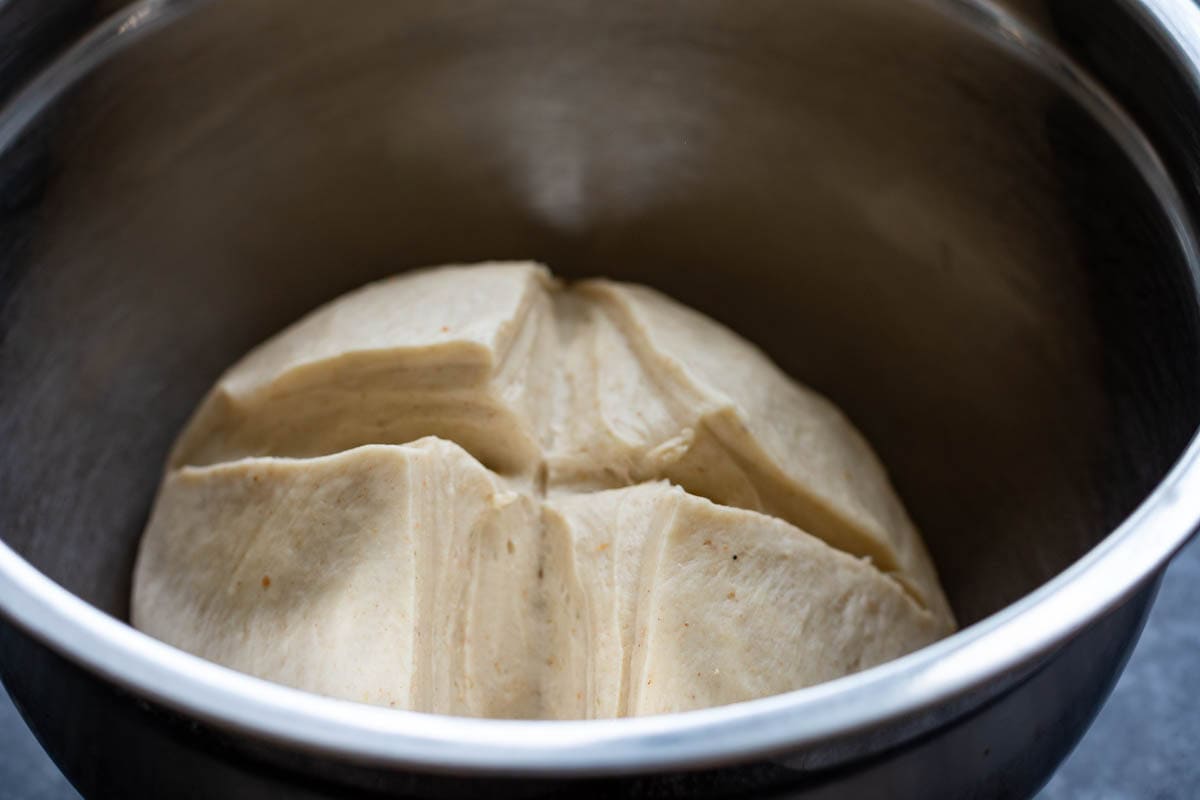
3. On a clean work surface, using a dough scraper, shape a tight ball, and slash the dough with a very sharp knife (a razor or a dough scorer) in a cross on top of the dough. This will help you roll the dough out into a square rather than a circle.
Bulk Fermentation & Cold Proof
1. Place the dough in a lightly greased bowl. Cover and let the dough rise in a warm spot for approx. 4 hours. Ideally, you need a temperature of 21-27°C.
2. Place the dough in the fridge for another 3-4 hours to finish proving and almost double in size (you may leave it in the fridge overnight). Finishing with a cold-proof helps roll the dough out later as it will be nice and firm and enhances the sourdough tang.
Butter Parcel
1. Take the butter out of the fridge in advance so it is just soft enough (you want it firm but malleable) to be rolled. Place it on a large sheet of baking parchment.
2. Place another sheet of parchment on top. Using a rolling pin, gently bash to flatten the butter. Then fold the baking parchment under into a neat 18x18cm (7×7 in) square and roll the butter inside the parchment parcel into all four edges, aiming for the same thickness across. Enclosing the butter into the baking parchment square will help you get an even butter square with sharp edges. Still wrapped in the baking parchment, place the butter in the fridge to firm up. This can be done far in advance.


Encasing Butter in Détrempé
1. Take the dough out of the fridge and place it onto a lightly floured work surface. Take the butter out of the fridge to soften a little as well (more tips on the temperature of the butter and the dough in the next section). Knock the air out with the bottom of your palm and roll it into a large rectangle around 18x36cm (7x14in). Try to make it even.
2. Unwrap the butter block. Place the butter in the middle of the dough.
3. Fold both sides over the butter to meet in the middle. Then pinch the edges of the dough together to seal in the butter. You should now have a 20x20cm (8x8in) butter parcel. Wrap dough in cling film and freeze on a flat surface for 10 minutes.


IMPORTANT Note On Butter and Dough Temperature
An important element of making the flakiest of sourdough croissants is ensuring the butter doesn't melt into the détrempé dough in the lamination process. In order to achieve this, you need your butter and dough of similar temperatures (or the dough slightly colder).
What is more, you don't want the butter too cold either, otherwise, it will brittle instead of creating even layers when you try to roll the pastry. Judging the right temperature of the dough and the butter will come with practice, but if the butter is too hard, just leave it out to soften.
You may also find that your detrempe warms up too much whilst you roll it out. In this case, wrap it up well in plastic wrap and place it in the freezer for 20 minutes before encasing the butter. It takes a little practice and a bit of in-and-out of the fridge and freezer, but if you get the dough and the butter the same level of softness you will be rewarded with amazing flaky layers and the best texture, trust me!
Book Fold
1. Take the parcel out of the freezer, unwrap and roll the parcel out into a rectangle that's around 20x50cm (8x20in). Make sure your dough isn't sticking to the worktop as you roll: you want the butter encased and the dough may tear if it sticks. Dust with flour if needed. Using a sharp chef's knife or a pizza cutter, cut off any untidy short edges that don't have any butter in them.
2. Take the short end of the dough and fold it into the centre. Take the other edge of the pastry and fold it into the middle, so that the two edges align in the middle. Then close the two sides as if you're closing a book.

3. TOP TIP: before you fold the pastry over, make sure to brush off any excess flour that may linger on the surface.
4. Wrap the dough in cling film (plastic wrap) and place in the freezer for 15 minutes, then transfer to the fridge for 1 hour. This will slow down the yeast in the dough. Chilling the pastry will also make it easier to roll out as it will contract less.
Letter Fold
1. Take the dough out of the fridge and place it short edge in front of you on a lightly floured surface. Roll the dough out to 20x50cm (8×20 in) again.
2. Fold the top third of the dough towards the centre and then the bottom third of the dough over (just like a letter or a pamphlet).

3. Wrap and place the pastry in the freezer for 15 minutes, then fridge for 4 hours. This is needed to slow down the yeast colonies rising the dough. It's not time for that yet 🙂 You can also leave the pastry to chill overnight.
Shaping and Filling
1. Prepare the filling ingredients. Drain and chop the jalapenos. Coarsely grate (shred) cheddar.
2. Take the pastry out of the refrigerator and let it warm up for 5 minutes at room temperature. Unwrap and, on a lightly floured worktop, roll the pastry out into a 60x40cm (24×16 in) rectangle, gently getting all the air out of the pastry. You don't want pockets of air to burst abruptly though, exposing the butter.
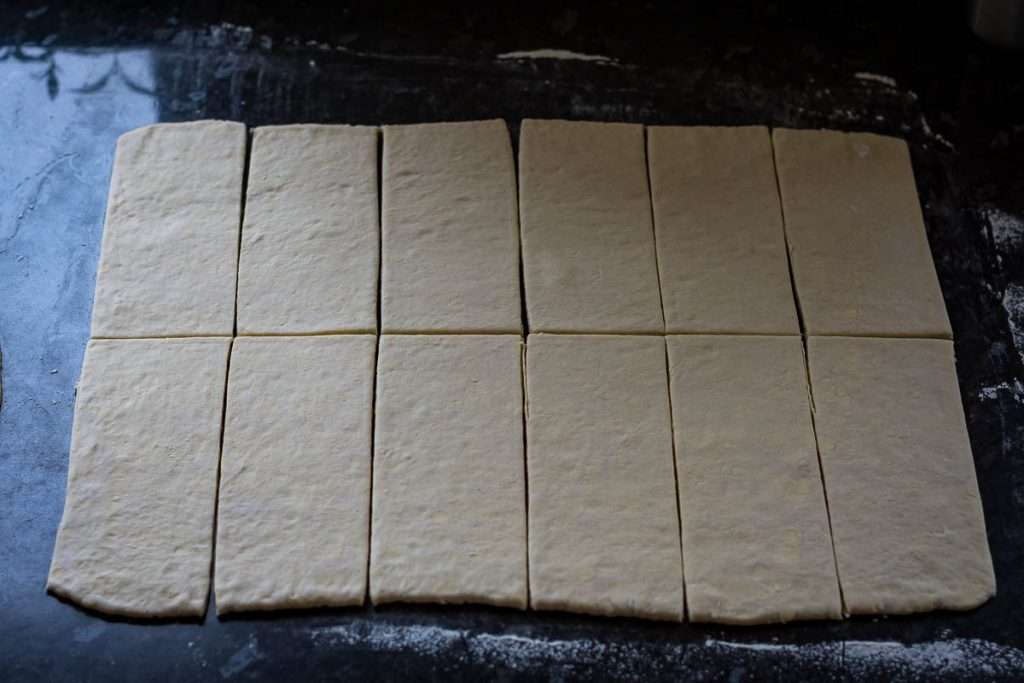
3. Trim the pastry from all four sides to create even edges. Using a sharp knife or a pizza cutter, cut the pastry sheet in half lengthways. Then each long strip into 6 rectangles measuring 20x10cm (8x4in). You should have 12 even rectangles.

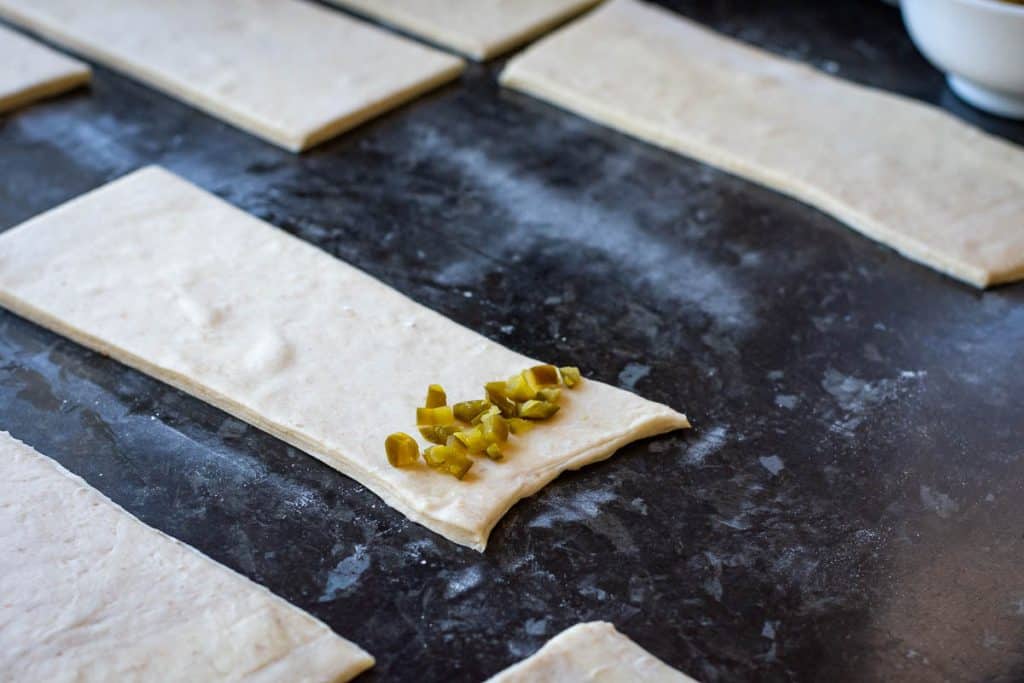
4. Taking one dough rectangle at a time, scatter a little jalapenos towards the bottom short edge, about 1-2 cm away from the edge). Add 1/12 of the grated cheese on top. Fold the pastry over the jalapenos and cheese and roll until you have a neat spiral, tucking the cheese that's trying to escape back into the pastry roll.


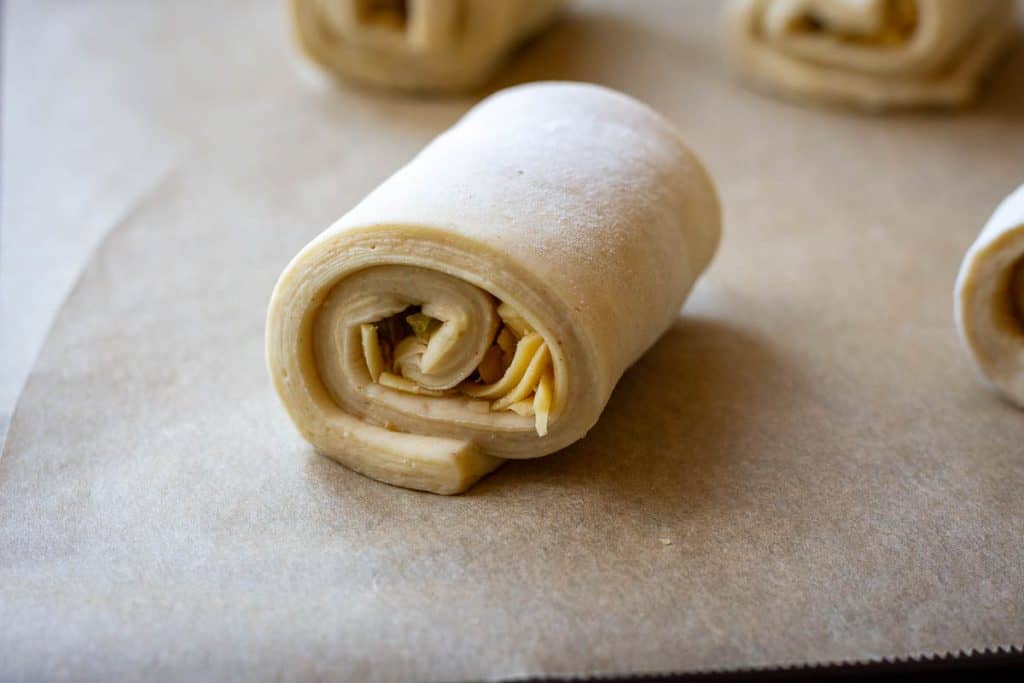
5. Repeat with the rest of the rectangles. Place the sourdough croissants seam side down on the prepared baking sheet, spaced out, leaving enough space for them to rise.
Proofing Shaped Savoury Pastries
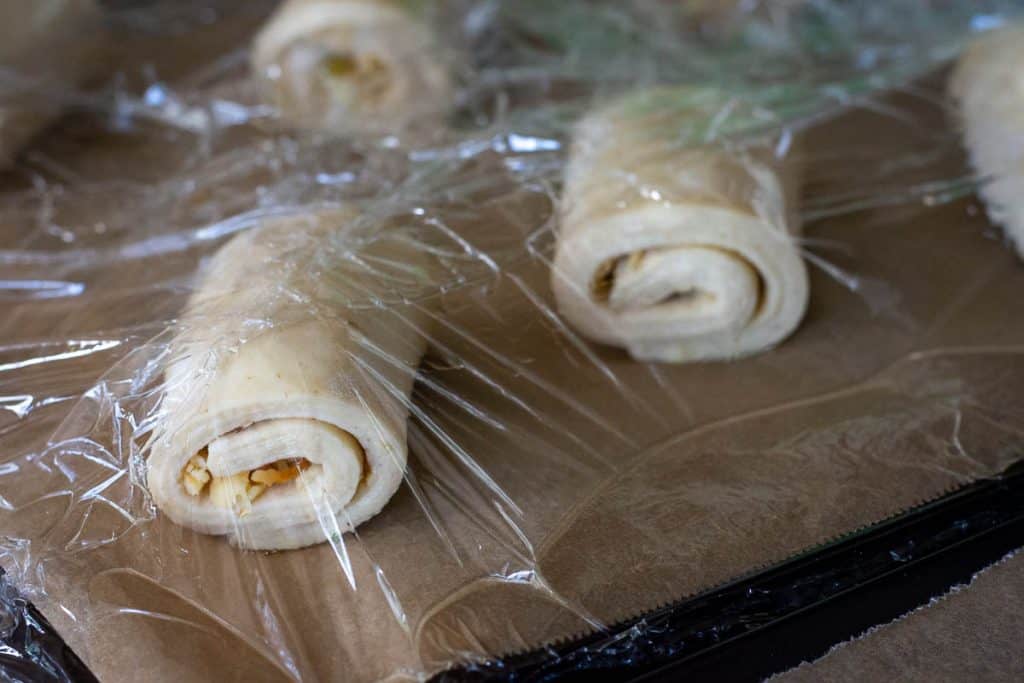
1. Cover the pastries with oiled cling film and leave them to proof in a warm spot (around 23°C) for 4 hours.
***If your kitchen is very cold, or you live in a particularly dry climate, you can pour boiling water into an ovenproof dish and place it in the turned off oven. The steam will raise the temperature and humidity. Leave the hot water in the oven for 10 minutes. Once the temperature in your oven is no higher than 23°C (any higher and your butter will start melting into the pastry), place the plastic-wrap-covered croissants into the steamy oven. The humid environment will ensure that the savoury croissants won't form a crust on top, preventing the pastries from rising.***
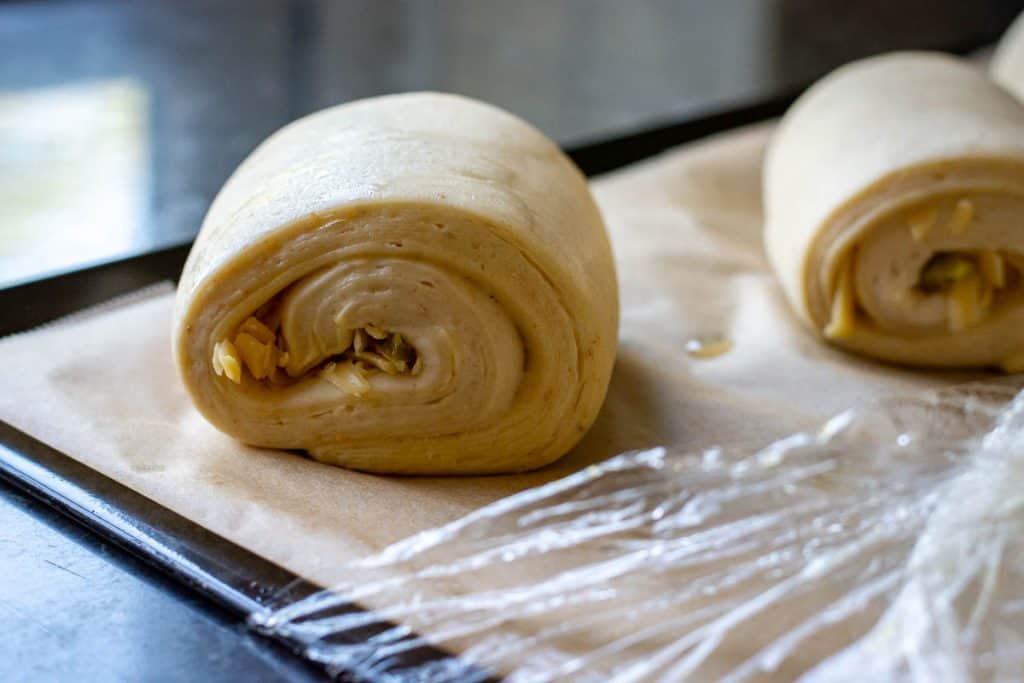
3. The pastries should puff up significantly and the layers should be clearly visible.
Eggwash
1. If using caraway seeds, crush them in a pestle and mortar. If you want more flavour, add a pinch of garlic powder (or onion powder) and a pinch of salt to the caraway seeds.
2. Once your savoury croissants have proved, we like to place them in the fridge for 15-20 minutes. The pastries will firm up and won't be as fragile when you are brushing them with egg wash. Furthermore, the butter in them will have time to solidify a bit again to help create perfect flaky layers.
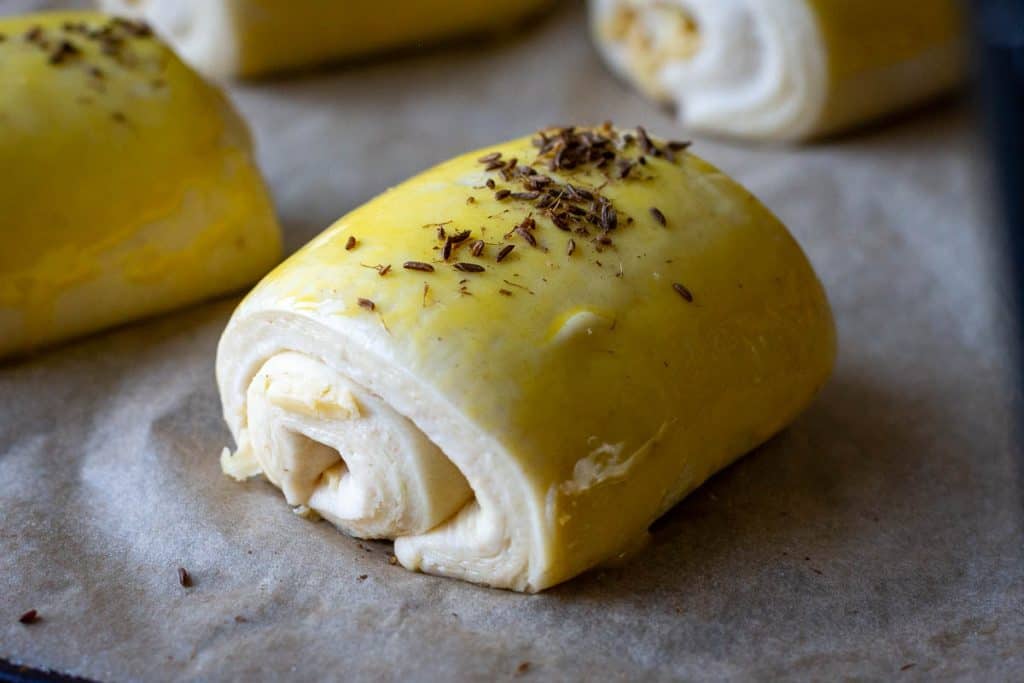
3. In a small bowl, whisk the egg yolk and cream (or milk). Using a pastry brush, very gently brush the pastries with the mixture. The egg wash will give the top of the croissants a golden brown finish. Sprinkle the top with caraway seeds.

Baking Savoury Croissants
1. Bake the pastries for around 20-25 minutes.
2. Leave the croissants to cool for 30 minutes. They are best served on the same day! We enjoy them most when they are still a little warm and the cheese is oozing out!

Recipe Video
Storage
These sourdough cheddar jalapeno croissants are best on the day they're baked - warm, crisp, and oozing cheese - but leftovers can absolutely be saved. Once cooled, pop them into an airtight container or a ziploc bag and keep at room temperature for up to 2 days. To bring back that just-baked magic, reheat in the oven at 160°C (320°F) for about 5-6 minutes.
Want to make a batch ahead? Freezing is a great way to keep them on standby. Freeze baked croissants - wrap individually, then reheat straight from frozen.
More Sourdough Pastries
Craving more flaky, buttery chaos? Here are a few more sourdough pastries worth rolling up your sleeves for.



Sourdough Smoked Cheddar and Jalapeno Croissants
Equipment
- Rolling Pin, we recommend using a stainless steel one
- Grater
Ingredients
For Détrempé:
- 450 g strong white bread flour with at least 12% protein content
- 150 g active sourdough starter 100% hydration
- 40 g caster sugar
- ¾ teaspoon salt
- 90 ml milk
- 130 ml water lukewarm
- 50 g butter room temperature
For Laminating:
- 250 g butter
For Filling:
- 50 g pickled jalapenos drained and chopped
- 200 g smoked cheddar coarsely grated
For Egg Wash:
- 1 egg yolk
- 1 tablespoon double/ heavy cream or milk
- 1 tablespoon caraway seeds optional
Instructions
DAY 1:
- First thing in the morning, feed the sourdough starter and leave it in a warm place (ideally between 21-27°C), loosely covered, for 4 hours. The starter should double in size by then. If it doesn't, it might need a few more good feedings to be ready.
Détrempé
- In a bowl of a stand mixer (we absolutely love our Kenwood), fitted with a dough hook attachment, mix the strong flour, salt and sugar. Pour in the water, milk and active sourdough starter. Turn the stand mixer on and knead for 5 minutes at medium speed. The dough will come together into a rather stiff ball (don't expect it to look smooth or elastic at this stage, it may even look a bit dry). Let the dough rest for 15 minutes.
- Run the stand mixer again on medium speed, and start adding 50g of room temperature butter a little bit at a time. Make sure your butter is soft (hard butter will have trouble combining with the dough). Keep the mixer running for around 8-10 minutes until the butter is fully incorporated and you have a smooth dough. It shouldn't be sticky.
- On a clean work surface, using a dough scraper, shape a tight ball, and slash the dough with a very sharp knife (a razor or a dough scorer) in a cross on top of the dough (see photos in the text above). This will help you roll the dough out into a square rather than a circle.
Bulk Fermentation
- Place the dough in a lightly greased bowl. Cover and let the dough rise in a warm spot for approx. 4 hours. Ideally, you need a temperature of 21-27° C.
- Place the dough in the fridge for another 3-4 hours to finish proving and almost double in size (you may leave it in the fridge overnight). Finishing with a cold-proof helps roll the dough out later as it will be nice and firm.
Butter Parcel
- Take the butter out of the fridge in advance so it is soft enough (you want it firm but malleable) to be rolled. Place it on a large sheet of baking parchment. Place another sheet of parchment on top. Using a rolling pin, gently bash to flatter the butter. Then fold the baking parchment under into a neat 18x18cm (7×7 in) square and roll the butter inside the parchment parcel into all four edges, aiming for the same thickness across (for process photos see below). Enclosing the butter into the baking parchment square will help you get an even butter square with sharp edges. Still wrapped in the baking parchment, place the butter in the fridge to firm up. This can be done far in advance.
Encasing Butter in Détrempé
- Take the dough out of the fridge and place it onto a lightly floured work surface. Take the butter out of the fridge to soften a little as well (more tips on the temperature of the butter and the dough in the next section). Knock the air out with the bottom of your palm and roll it into a large rectangle around 18x36cm (7x14in). Try to make it even.
- Unwrap the butter block. Place the butter in the middle of the dough.
- Fold both sides over the butter to meet in the middle. Then pinch the edges of the dough together to seal in the butter. You should now have a 20x20cm (8x8in) butter parcel. Wrap dough in cling film and freeze on a flat surface for 10 minutes.
IMPORTANT Note On Butter and Dough Temperature
- An important element of making the flakiest of sourdough croissants is ensuring the butter doesn't melt into the détrempé dough in the lamination process. In order to achieve this, you need your butter and dough of similar temperatures (or the dough slightly colder).
- What is more, you don't want the butter too cold either, otherwise, it will brittle instead of creating even layers when you try to roll the pastry. Judging the right temperature of the dough and the butter will come with practice, but if the butter is too hard, just leave it out to soften.
- You may also find that your detrempe warms up too much whilst you roll it out. In this case, wrap it up well in plastic wrap and place it in the freezer for 20 minutes before encasing the butter. It takes a little practice and a bit of in-and-out of the fridge and freezer, but if you get the dough and the butter the same level of softness you will be rewarded with amazing flaky layers, trust me!
Book Fold
- Take the parcel out of the freezer, unwrap and roll the parcel out into a rectangle that's around 20x50cm (8x20in). Make sure your dough isn't sticking to the worktop as you roll: you want the butter encased and the dough may tear if it sticks. Dust with flour if needed. Using a sharp chef's knife or a pizza cutter, cut off any untidy short edges that don't have any butter in them.
- Take the short end of the dough and fold it into the centre. Take the other edge of the pastry and fold it into the middle, so that the two edges align in the middle. Then close the two sides as if you're closing a book.
- TOP TIP: before you fold the pastry over, make sure to brush off any excess flour that may linger on the surface.
- Wrap the dough in cling film (plastic wrap) and place in the freezer for 15 minutes, then transfer to the fridge for 1 hour. This will slow down the yeast in the dough. Chilling the pastry will also make it easier to roll out as it will contract less.
Letter Fold
- Take the dough out of the fridge and place it short edge in front of you on a lightly floured surface. Roll the dough out to 20x50cm (8×20 in) again.
- Fold the top third of the dough towards the centre and then the bottom third of the dough over (just like a letter or a pamphlet).
- Wrap and place the pastry in the freezer for 15 minutes, then fridge for 4 hours. This is needed to slow down the yeast colonies rising the dough. It's not time for that yet 🙂 You can also leave the pastry to chill overnight.
DAY 2 or 3:
Shaping and Filling
- Take the pastry out of the refrigerator and let it warm up for 5 minutes at room temperature. Unwrap and, on a lightly floured worktop, roll the pastry out into a 60x40cm (24×16 in) rectangle, gently getting all the air out of the pastry. You don't want pockets of air to burst abruptly though, exposing the butter.
- Trim the pastry from all four sides to create even edges. Using a sharp knife or a pizza cutter, cut the pastry sheet in half lengthways. Then each long strip into 6 rectangles measuring 20x10cm (8x4in). You should have 12 even rectangles.
- Taking one dough rectangle at a time, scatter a little jalapenos towards the bottom short edge, about 1-2 cm away from the edge). Add 1/12 of the grated cheese on top. Fold the pastry over the jalapenos and cheese and roll until you have a neat spiral, tucking the cheese that's trying to escape back into the pastry roll.
- Repeat with the rest of the rectangles. Place the sourdough croissants seam side down on the prepared baking sheets spaced out, leaving enough space for them to rise.
Proofing Shaped Savoury Pastries
- Cover the pastries with oiled cling film and leave them to proof in a warm spot (around 23°C) for 4 hours.
- If your kitchen is very cold, or you live in a particularly dry climate, you can pour boiling water into an ovenproof dish and place it in the turned off oven. The steam will raise the temperature and humidity. Leave the hot water in the oven for 10 minutes. Once the temperature in your oven is no higher than 23 C (any higher and your butter will start melting into the pastry), place the plastic-wrap covered croissants into the steamy oven. The humid environment will ensure that the savoury croissants won't form a crust on top, preventing the pastries from rising.
- The pastries should puff up significantly and the layers should be clearly visible.
Eggwash
- If using caraway seeds, crush them in a pestle and mortar.
- Once your savoury croissants have proved, we like to place them in the fridge for 15-20 minutes. The pastries will firm up and won't be as fragile when you are brushing them with egg wash. Furthermore, the butter in them will have time to solidify a bit again to help create perfect flaky layers.
- Preheat the oven to 190°C (375℉).
- In a small bowl, whisk the egg yolk and cream (or milk). Using a pastry brush, very gently brush the pastries with the mixture. The eggwash will give the top of the croissants a golden brown finish. Sprinkle the top with caraway seeds.
Baking Savoury Croissants
- Bake the pastries for around 20-25 minutes. Leave the croissants to cool for 30 minutes. They are best served on the same day! We enjoy them most when they are still a little warm and the cheese is oozing out!
Video
Nutrition




Leave a Reply